
What is a placket?
A placket is a finished, reinforced opening in a garment that lets it open for dressing and gives the closure something to fasten to. The raw edges of a cut slit are bound or folded so they do not fray, and the placket carries the buttons, snaps, or zip.
The word covers several things at once, which is why it confuses people. A shirt has a front placket down the chest and a sleeve placket at each wrist, and plackets also appear at necklines and in side seams.
A placket is small, but it is one of the clearest signals of how a garment is made. It is a high-stress opening handled many times a day, so a cheap one gapes, tears, or twists, while a well-built one stays flat and square for the life of the shirt.
This guide takes them by location, front, then sleeve, then neckline, then how a placket is built, what a good one looks like, and how it is specced.
Shirt front plackets
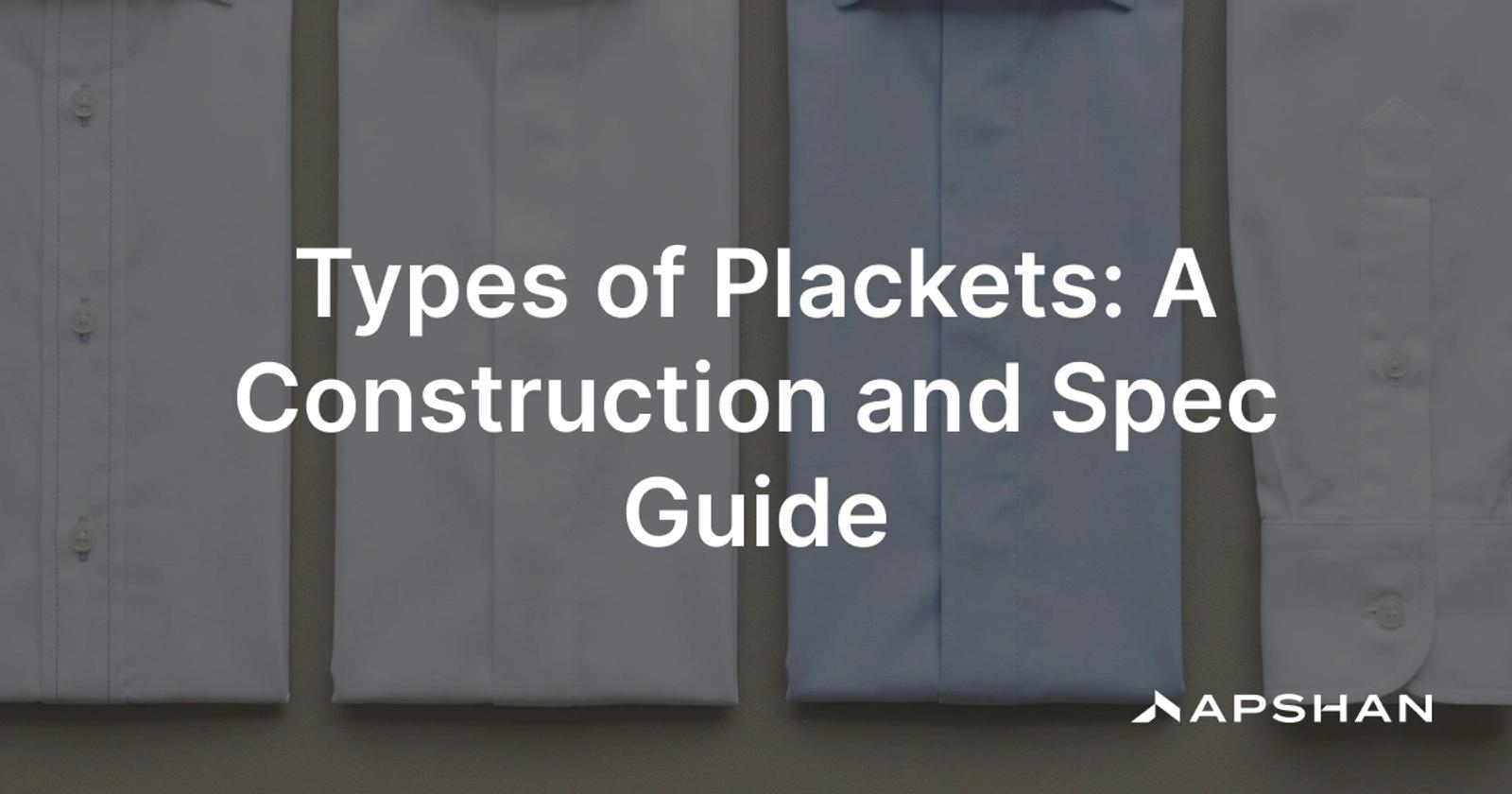
The front placket is the strip down the centre of a shirt that holds the buttons and buttonholes. It comes three main ways, plus two dressier variants, and the choice quietly sets the shirt's formality, from a workwear standard band to a black-tie fly front.
- Standard or box placket: a folded strip of fabric, sometimes a separate piece, stitched down the front with two rows of topstitching, usually about 1.5 inches wide. Visible buttons, a clean business look, and the most common front, since the topstitched band adds a little structure and is quick to make.
- French front (no placket): the front edge is folded back to the inside and stitched from behind, so there is no separate band and no topstitching on show. A clean, elegant front, often favoured on dress shirts, and usually built over a strip of interfacing to hold the buttonholes.
- Covered or fly front: an extra flap of fabric hides the buttons entirely, for the cleanest, most formal look. The tuxedo-shirt front, though it will not take decorative button studs because the buttons are concealed.
- Popover placket: a front placket that runs only partway down, so the shirt pulls on over the head instead of opening fully. Sporty and casual, usually with three buttons, seen on overshirts and safari styles.
- Pleated tuxedo front: a stiffened, pleated panel on the shirt front for black tie, its top buttons often replaced with studs. A dress-occasion front rather than an everyday one.
Sleeve plackets
A sleeve placket finishes the slit at the wrist that lets the cuff open wide enough for the hand to pass through. It sits on the sleeve just above the cuff, and there are two main ways to build it, plus simpler variants that trade finish for speed.
- Tower or house placket: the tailored shirt placket, a shaped piece that hides every raw edge inside a pointed or square tower and is topstitched around it. A bar tack at the base strengthens the opening, and the whole detail is the mark of a quality shirt sleeve, though it is fiddly and slow to sew.
- Continuous bound placket: a single strip of fabric bound around the slit, simpler and more common on blouses, casual shirts, and children's wear. Faster to sew, with less structure than a tower, and it can gape more since it is a single lapped layer.
- Faced placket: a facing turned to the inside finishes the slit with nothing showing outside, used on lightweight and dressy garments where a topstitched tower would be too heavy.
- Inseam or mandarin placket: the opening is left in a seam rather than cut into the panel, the simplest finish of all, common on casual sleeves and where a seam already sits near the wrist.
- Mock placket: a placket that looks like a tower from the outside but is built more simply behind, a shortcut used to keep the look while cutting the labour.
Above the sleeve placket, a small gauntlet button often closes the gap on the forearm, so the sleeve does not gape when the cuff is buttoned.
Neckline and other plackets
Plackets are not only for shirt fronts and cuffs. Any opening that needs finishing and a closure can carry one.
- Polo placket: a short front placket on a knit polo, with two or three buttons, topstitched onto the jersey and often reinforced so the knit does not stretch.
- Henley placket: a buttoned neckline placket with no collar, on knit tops and casual shirts, a shorter cousin of the popover front.
- Zip placket: a placket built around a zip rather than buttons, on jackets, dresses, and technical wear, sometimes with a storm flap over the teeth.
- Side-seam and skirt plackets: a finished opening in a side or back seam of a skirt or trousers, closing with a zip, buttons, or hooks, so the garment can be stepped into or pulled on.
How a placket is built, and where it fails
Every placket does the same job: it turns a raw cut in the cloth into a clean, strong opening that can be fastened and unfastened for years. The maker cuts the slit, folds or binds the edges so they cannot fray, adds a facing or a separate band, then topstitches the whole thing down flat. Two things make or break it, and both are easy to skimp on.
- The base of the slit: the point where the opening ends takes all the strain when the placket is pulled apart, so it is the first place to tear. It is reinforced, usually with a bar tack, and stitched like any seam that carries load.
- Interfacing: a front placket is interfaced so it stays crisp and the buttons and buttonholes do not stretch out with use. A limp, un-interfaced placket that curls or waves is a reliable tell of a cheap shirt.
A placket also has to lie flat, with the two sides aligned, so a shirt front closes on a straight line. On a tower sleeve placket, hiding every raw edge inside the tower is what separates a tailored shirt from a home-made one.
What a good placket looks like
A few tells separate a well-made placket from a cheap one, and they are worth checking on a sample and writing into a spec.
- Even, straight topstitching: the rows are parallel and a consistent distance from the edge, with no wobble, puckering, or skipped stitches, which is where a rushed factory shows itself first.
- Aligned sides: the two halves of a front placket meet on a straight vertical line, and the buttons and buttonholes line up so the shirt does not pull or twist across the chest.
- Hidden raw edges: no raw or overlocked edges show inside a tower placket or a French front; everything is enclosed, which is the slow, careful part that cheaper shirts skip.
- A reinforced base: the bottom of every slit is bar-tacked so it cannot tear, and the front placket is interfaced so nothing stretches out over time.
- The gauntlet button: its presence on a sleeve is a small but reliable sign of a considered, better-made shirt, since it is an extra operation that budget shirts drop.
How to spec a placket in a tech pack
On a tech pack, a placket is a set of construction choices, not a single line item. Spell out each of these and the factory reproduces the same placket across the whole run, so it closes cleanly and holds up in wear.
- Type and location: standard, French, or fly at the front; tower or continuous bound at the sleeve; and exactly where each opening sits and how far it runs.
- Length and width: the finished placket length and width, and, for a front placket, the number of topstitch rows and their spacing from the edge.
- Interfacing and reinforcement: the interfacing weight on the front placket, and the bar tack or reinforcement at the base of every slit, front and sleeve.
- Closure: the buttons, snap, or zip the placket carries, specced with the tech pack and reproduced through textile manufacturing across the run.
How to choose the right placket
Work from the garment and the formality. The front placket sets the shirt's dress level, and the sleeve placket sets how tailored it reads, and the two are usually chosen to match rather than mixed.
- Formal shirts: a French or fly front, with a tower sleeve placket, for the cleanest, dressiest result.
- Business and casual shirts: a standard front placket with a tower sleeve placket, or a continuous bound placket to keep costs down.
- Knit tops: a polo or henley placket, topstitched onto the jersey and reinforced so the knit does not stretch at the buttons.
- The pairing: the front placket, the collar, and the sleeve placket are the shirt's three signature details, best specced together.
Getting a placket specced and built right is where fashion-native knowledge helps. Apshan's Nari knowledge graph answers questions like placket construction and spec conventions, cited to source, inside the AI assistant your team already uses. Request access.