
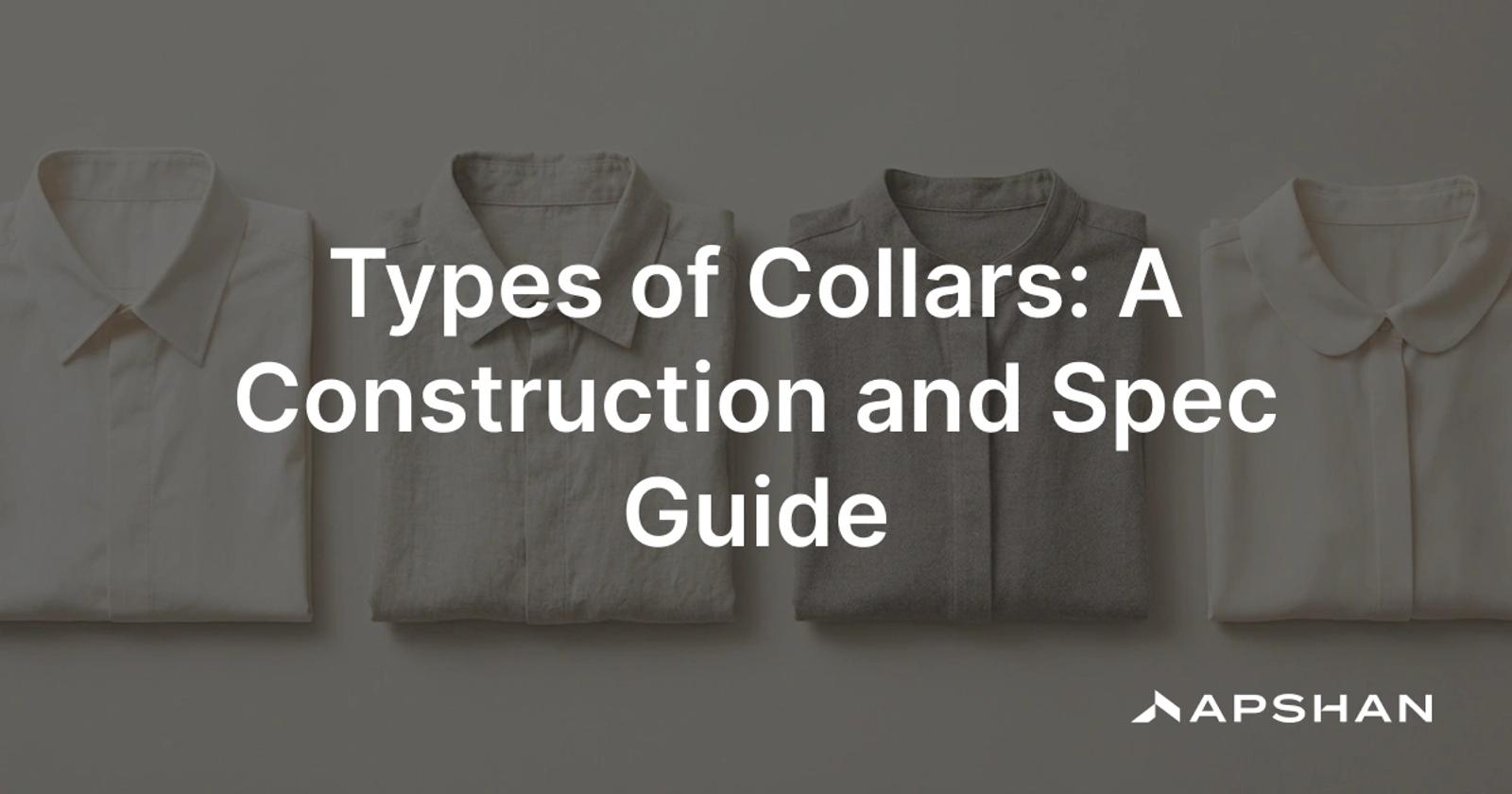
A collar is a small piece of cloth that carries a large share of a garment's quality. It frames the face, it is the first thing an eye lands on, and it is one of the hardest components to make well. Count the named styles and you reach fifty or more; for a designer or product developer the number that matters is three, the construction families that decide how a collar is patterned, sewn and specced.
This guide sorts collars the way a shirt room does, by construction first and style second, and shows how to specify one in a tech pack.
What are the types of collars?
Collars are classified two ways. By construction, meaning how the collar sits on the neck, there are three families: flat, rolled and standing. By style, meaning the named shape, there are dozens, from the point and spread collars of a dress shirt to the mandarin, the Peter Pan and the camp collar.
The distinction matters because construction, not style, is what the pattern and the sewing line work with. A point collar and a spread collar are the same rolled construction with different point angles; a mandarin and a wing collar are both standing collars. Fix the construction and the style is a variation on top.
Why does the collar matter?
The collar sits closest to the face, so it sets the tone of a garment and is judged before anything else. It is also the small part where poor making shows most clearly.
- Quality tell: mismatched points, a collar that will not hold its roll, or a puckered stand are the first signs of a cheaply made shirt; a clean, symmetrical collar reads as quality instantly.
- Skill and cost: a two-piece shirt collar with a separate stand is one of the more skilled operations on the line, so the collar choice moves both the labour cost and the reject rate.
- Fit and comfort: the stand height and neck edge decide how the collar sits against the neck; too high it chokes, too low it gapes away from the neck.
- Design signature: collar shape dates and defines a garment, from a 1970s long point to a mandarin on a minimalist shirt, more than most other details.
The anatomy of a collar
A handful of terms recur through every collar type, and they are the words a tech pack uses. Knowing them makes the rest of this guide precise rather than approximate.
- Stand (or band): the part that holds the collar up from the neckline; on a dress shirt it is a separate piece, and its height sets how high the collar sits on the neck.
- Roll line: the line where a collar stops standing and folds over; where it sits decides how much stand shows and how much fall drapes onto the garment.
- Fall: the part of the collar below the roll line that folds down and lies on the garment; on a rolled collar it is the part that shows from above.
- Points and spread: the points are the tips of the collar; the spread is the distance between them, the measure that separates a point collar from a cutaway.
- Tie space: the gap at the front of the collar band where the two sides meet above the top button, the room a tie knot sits in; some collars have none.
- Neck edge: the lower edge of the stand that is stitched to the garment neckline, the join that ties the collar to the body.
Collars by construction: the three families
These three families cover how almost every collar sits on the neck. Each carries its own pattern, fit and production trade-offs.
- Flat collar: lies flat on the shoulders with almost no stand, following the neckline curve. The Peter Pan is the classic example. Simple to draft and sew, common on blouses, dresses and childrenswear. See textile manufacturing for where it sits in the make.
- Rolled collar: stands up from the neckline, then folds over at the roll line to fall on the garment. This is the largest family and includes the classic turndown shirt collar. It gives the most tailored look and needs the most skill, because the roll has to hold.
- Standing collar: stands up around the neck with no fold, finishing at the top edge. The mandarin or band collar is the plain version; the wing collar is a formal one. Clean and modern, and simpler than a rolled collar.
For a brand this is a cost and skill map as much as a vocabulary. Flat collars are the cheapest and most forgiving; standing collars are simple; the rolled shirt collar, especially with a separate stand, is the one that needs a skilled operator and the tightest spec.
The named collars, shirt and tailoring
Style names describe the shape of the collar, and almost all of them are variations on the three families. Grouping them by family is more useful than an alphabetical list, because the family tells you how each is built.
- Dress-shirt turndown (rolled): point (narrow, classic), spread and cutaway (points angled wide for a large tie knot), semi-spread (the middle ground), button-down (points buttoned to the body), club (rounded points) and tab (a tab links the points under the knot).
- Standing: mandarin or band (a short upright band, open at the front), Nehru (a band on a jacket) and wing (a formal standing collar with the points folded out).
- Flat: Peter Pan (round-cornered, flat), sailor (a deep square back), and Bertha (a wide, flat collar over a low neckline).
- Jacket and one-piece: notch (a jacket collar that meets the lapel in a notch) and shawl (a continuous rounded jacket collar and lapel); plus the camp or convertible collar, a one-piece casual shirt collar with no separate stand, worn open or closed.
A collar is a separate piece added to a neckline, which is where the two meet: the neckline is the shape of the edge, and the collar is what is built onto it. A tech pack states which one it means so the pattern is drawn correctly.
What makes or breaks a collar: interfacing and the stand
Two construction choices decide whether a collar looks sharp or collapses by mid-afternoon, and neither is visible in a sketch. They are the difference between a sample that is approved and one that is sent back.
- Interfacing: a collar holds its shape because of the interfacing fused or sewn inside it; the collar and cuffs are the most interfaced parts of a shirt. Too soft and the collar curls; too stiff and it looks like cardboard; a fused interlining that is applied badly bubbles or peels after washing.
- Two-piece versus one-piece: a dress shirt uses a two-piece collar, a separate collar and stand, whose forced curves give a clean roll and let the collar sit up under a jacket. A one-piece collar, like a camp or convertible, has no separate stand and lies flatter, which is simpler to sew but softer in shape.
This is why the spec must name both the interfacing and the construction, not just the style. The same point collar is a crisp dress shirt or a soft casual shirt depending on these two lines, and only the tech pack records which one was intended.
How to spec a collar
For a brand, a collar is a fit, quality and cost decision, and specifying it fully is what stops the factory from guessing. A complete collar spec names both the shape and the build.
- Spec it precisely: family and style name, stand height, point length, spread or point-to-point, tie space, and the interfacing type and weight, each with a tolerance, in the tech pack, so the pattern and the sample match.
Most collar faults trace back to a missing line in that spec.
- Points do not match: the two point lengths differ, the clearest sign of a poorly sewn collar; state the point length and a tight symmetry tolerance.
- Roll collapses: the wrong interfacing weight, so the collar will not hold its stand; specify the interfacing, not just the fabric.
- Stand gapes or chokes: the stand height or neck edge is off for the neck; give the stand height and check it on the fit sample.
- Points fray or turn blunt: points cut or turned badly; call out a clean, sharp, fully turned point.
It also pays to approve a sewn fit sample, not just a flat sketch. A collar reads very differently on paper and on the body, so the approved sample becomes the real spec and the measurements point back to it.
The collar is one line in a garment's construction story, tied to the block, the fabric and the finish on every unit. Apshan structures that fashion knowledge, cited to source, so a design decision is grounded rather than guessed. Request access or see the plans and pricing.