
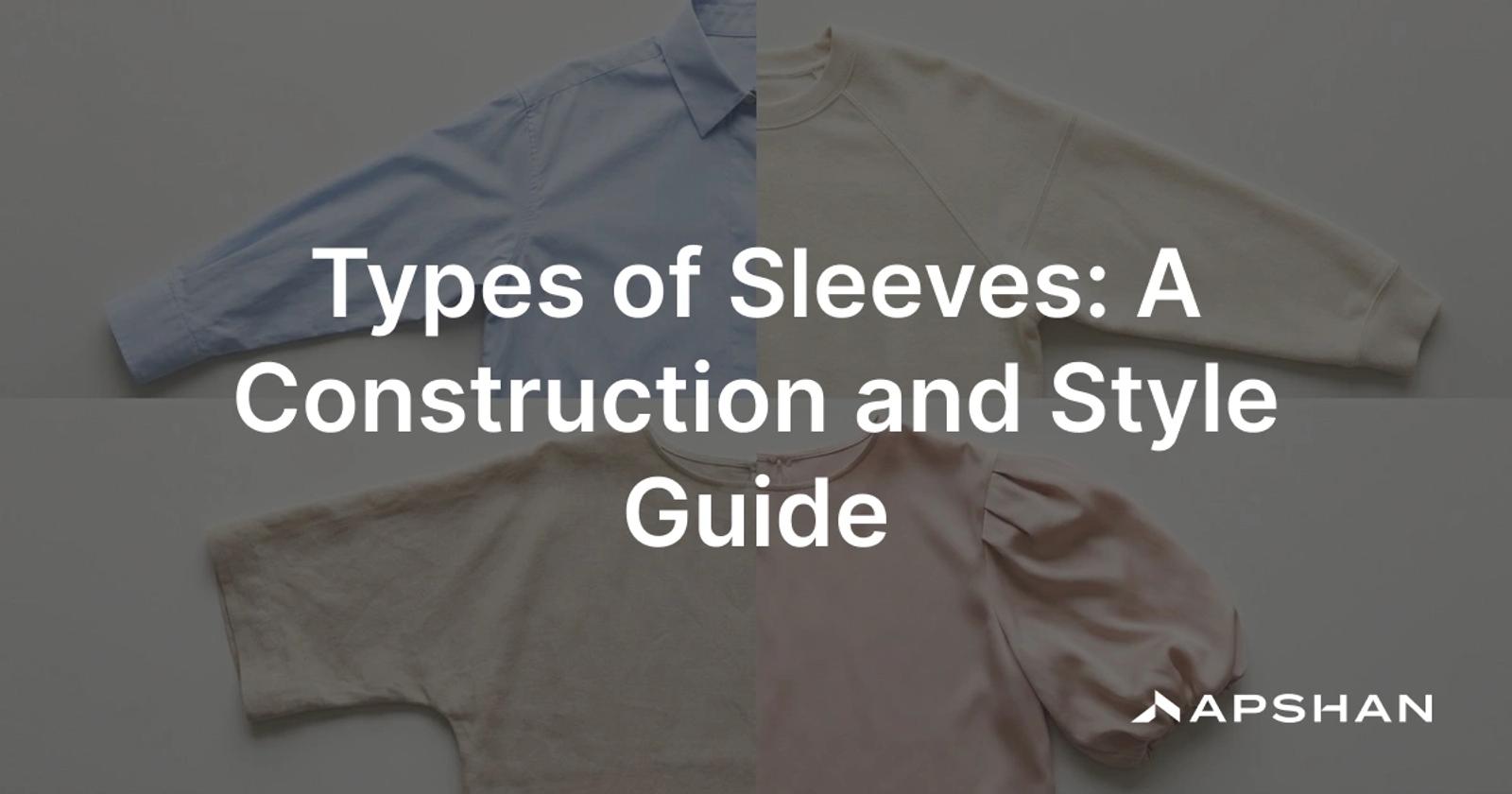
Ask how many types of sleeves there are and you will get answers from 15 to 80. Both are right and neither is useful, because they are counting styles. For a designer or product developer, the number that matters is four: the construction families that decide how a sleeve is patterned, how it fits, and what it costs to make.
This guide sorts sleeves the way a workroom does, by construction first and style second, and shows how to specify one in a tech pack.
What are the types of sleeves?
Sleeves are classified two ways. By construction, meaning how the sleeve attaches to the bodice, there are four families: set-in, raglan, cut-on (kimono, dolman and batwing), and drop-shoulder. By style, meaning the shape and fullness, there are dozens of named sleeves, from puff to bishop to leg-of-mutton.
The distinction matters because construction, not style, is what a pattern maker actually works with. A puff sleeve and a plain sleeve can share the same set-in construction; a batwing and a kimono are both cut-on. Get the construction right and the style is a variation on top of it.
Why does the sleeve type matter?
The sleeve is deceptively important. It is one of the hardest parts of a garment to fit, one of the clearest cost drivers, and often the single detail that dates or defines a design.
- Fit and mobility: the sleeve and its armhole decide how freely the wearer can move; a good bodice with a badly cut sleeve is uncomfortable and comes back as a return.
- Production cost and skill: a set-in sleeve needs a skilled operator to ease the cap; the wrong choice raises the labour cost or the reject rate.
- Fabric consumption: cut-on and heavily gathered sleeves use noticeably more cloth, which multiplies across an order.
- Design signature: from the 1890s gigot to the 2020s puff, the sleeve is often what makes a silhouette feel of its moment.
The anatomy of a sleeve
A few terms recur through every sleeve type, and they are the words a tech pack uses. Knowing them makes the rest of this guide precise rather than approximate.
- Armscye (armhole): the opening in the bodice the sleeve fits into; its shape and depth decide how the arm moves.
- Sleeve cap: the curved top of a set-in sleeve that is eased into the armscye; cap height trades a clean fit against freedom of movement.
- Bicep line: the widest part of the sleeve, measured around the upper arm; the fit point that most often feels tight.
- Underarm seam: where the sleeve meets the side seam; on cut-on sleeves this seam carries the whole join, since there is no armhole seam.
- Sleeve opening: the hem or cuff at the wrist, from a plain finish to a buttoned cuff.
Sleeves by construction
These four families cover how almost every sleeve joins the body of a garment. Each carries its own fit, pattern and production trade-offs.
- Set-in sleeve: a separate sleeve piece sewn into the armhole (the armscye) with a seam that runs around the arm over the shoulder. It is the most common and the most tailored, and also the hardest to make well, because the rounded sleeve cap has to be eased smoothly into the armhole. Shirts, blouses and tailoring. See textile manufacturing for where it sits in the make.
- Raglan sleeve: attaches with a diagonal seam that runs from the underarm to the neckline, so there is no shoulder seam. It is easy to construct and forgiving to fit and grade, which is why it dominates sportswear, knits and casual outerwear.
- Cut-on sleeve (kimono, dolman, batwing, magyar): cut as one piece with the bodice, with no armhole seam at all. Kimono is the wide, straight, T-shaped version; dolman and batwing have a deep, low armhole that drops toward the waist and tapers to a fitted wrist. Simplest to sew, but the most fabric-hungry.
- Drop-shoulder sleeve: the armhole is dropped below the natural shoulder line, so the shoulder seam sits partway down the arm. Relaxed and oversized, easy to construct; the staple of casual knitwear and streetwear.
For a brand, this list is a cost and fit map as much as a vocabulary. Set-in gives the cleanest fit but needs the most skill; raglan and drop-shoulder are cheaper and more forgiving; cut-on is the simplest to assemble but eats fabric, which shows up in the cost sheet.
Sleeves by style (the named sleeves)
Style names describe the shape and fullness of the sleeve, and almost all of them are variations sewn onto a set-in construction. These are the ones that fill the 45-and-80-item lists, grouped by what they actually do.
- Volume at the shoulder: puff (gathered into the cap), leg-of-mutton or gigot (full at the shoulder, tapering tight to the wrist), and balloon (full and rounded, gathered at both cap and cuff).
- Volume lower down: bell and trumpet (fitted at the top, flaring out below), bishop (full length gathered into a cuff), lantern (ballooning out between the elbow and the wrist, gathered at both ends), and angel or cape (long, wide and flowing).
- Flat or minimal: cap (a short covering over the shoulder with little underarm), flutter (a short, soft frill), and petal or tulip (overlapping panels that wrap like petals).
- Openings and cut-outs: cold-shoulder (a cut-out at the shoulder), and slit or split sleeves (an open seam along the length).
- By length: cap, short, elbow, three-quarter, bracelet (ending just above the wrist) and full, the length terms that combine with any of the styles above.
None of these styles is tied to a single construction. A puff can be set into a normal armhole or built onto a raglan; a bell can finish a set-in or a cut-on sleeve. That is why the workroom fixes the construction first, then adds the style and the length on top.
How to choose and spec a sleeve
For a brand, choosing a sleeve is a fit, fabric and cost decision, and specifying it clearly is what stops the factory from guessing.
- Match it to the fabric: fullness needs a fabric that will drape or hold the way the design intends; a crisp puff and a soft flutter want very different cloth.
- Weigh the construction cost: a set-in sleeve costs more labour than a cut-on or raglan, and a cut-on or heavily gathered sleeve costs more fabric; the choice moves the garment's price.
- Spec it precisely: name the style and the construction, then give the points of measure, sleeve length, cap height, bicep and sleeve opening or cuff, in the tech pack, so the pattern and the sample match the sketch.
It also pays to reference a fit sample, not just a sketch. A sleeve reads very differently flat on paper and on the body, so the approved sample is the real spec; the drawing and the measurements point back to it.
The sleeve is one line in a garment's construction story, tied to the block, the fabric and the cost of every unit. Apshan structures that fashion knowledge, cited to source, so a design decision is grounded rather than guessed. Request access or see the plans and pricing.