
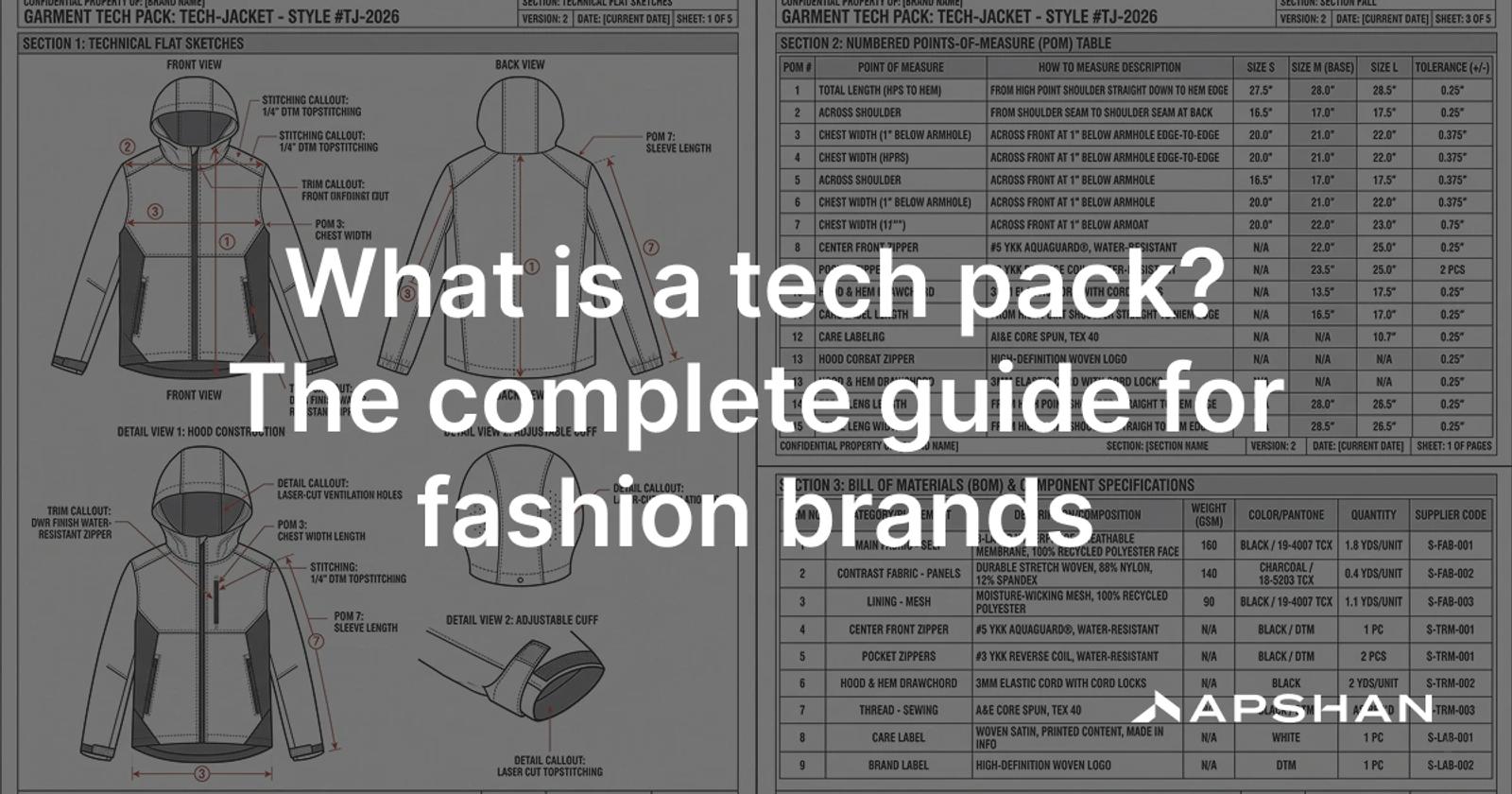
A factory cannot make what it cannot read. Hand a manufacturer a sketch and a vibe, and you will get back a garment built on guesses, yours corrected by theirs. Hand it a tech pack, and you get back what you actually designed. The tech pack is the difference between a sample that fits and a season of surprises.
This guide explains what a tech pack is, exactly what it contains, how it differs from a spec sheet, and how to build one that a factory can quote and produce from without inventing the parts you left out.
What is a tech pack?
A tech pack, short for technical package, is the blueprint of a garment: a multi-page document that tells a manufacturer exactly what to make and how. It gathers every technical detail, the sketches, materials, measurements, construction and finishes, into one reference the factory produces from and is measured against.
The comparison to a builder's blueprint is exact. No one builds a house from a photo; they build from plans precise enough that any competent crew produces the same result. A tech pack does the same for a garment: it removes interpretation. Most factories will not even quote a job without one, because without it they cannot price the work or guarantee the outcome.
What does a tech pack contain?
A complete tech pack is built from a set of standard blocks. The exact pages vary by product, but the core is consistent:
- A cover page: the model name and reference, brand, season, base size and revision date, the identity card of the document.
- Technical flats: flat, front-and-back line drawings of the garment, with callouts for pockets, panels, collars, zippers and plackets. Not a mood sketch, a precise plan.
- Bill of materials (BOM): every component listed, main fabric, lining, thread, trims, closures, labels and packaging, with references and suppliers. If it is on the garment, it is on the BOM.
- Measurement specification (POMs): the points of measure, each numbered, giving the finished dimensions of the garment in the base size.
- Grading: the rule that scales those measurements across the full size range, from XS to XXL, keeping proportions right.
- Colourways: each colour combination codified, ideally with Pantone references and placement, so the red on screen is the red on the fabric.
- Construction details: stitch and seam types, stitches per inch, seam allowances and workmanship notes, how the garment is actually assembled.
- Trims and labels: zippers, buttons, cords and elastics with sizes and codes, plus care and brand labels and their placement.
- Sample and revision log: fit comments, sample tracking and dated versions, because a tech pack is a living document, not a one-off.
The measurement spec and grading: the technical heart
If one part of a tech pack deserves absolute care, it is the measurement specification. It lists, point of measure by point of measure, the finished dimensions of the garment in its base size, each point numbered and tied to a location on the flat, for example chest width so many centimetres below the armhole.
Two things make it work. The first is grading: the rule that declines those measurements across the whole size range so a size 12 keeps the proportions of the sample. The second is tolerance, the accepted gap between the spec and the produced garment, written as plus or minus a value. A point of measure specified at 30 inches with a tolerance of plus or minus half an inch passes anywhere from 29.5 to 30.5; beyond that, the piece is off-spec and rejected.
A measurement always travels with the drawing. A number without a diagram showing where it is taken can be read ten ways, which is how two factories produce two different garments from the same spec. The points of measure are numbered in a consistent order, usually top to bottom, so the same code means the same measurement on every style and a factory can find point 015 without hunting for it.
Tech pack vs spec sheet vs line sheet
Three documents get confused, and mixing them up causes real problems in production and sales:
- The spec sheet is the list of points of measure that defines the garment's size. It is one page inside the tech pack, not the whole thing.
- The tech pack is the full production package: the spec sheet plus flats, BOM, construction, colourways and the rest. It is the instructions to the factory.
- The line sheet is a sales document, listing products, prices and order minimums for wholesale buyers. It never goes to the factory and carries no construction detail.
In short: the line sheet sells the product, the spec sheet sizes it, and the tech pack builds it.
Why a tech pack matters
A tech pack is both a contract and a cost driver. Complete, it produces an accurate quote, fewer sample rounds, consistent quality across factories, and a faster path to market. Incomplete, every gap becomes a decision the factory makes for you, and rarely in your favour.
The failure mode is predictable. What is not specified is interpreted, and the interpretation surfaces at delivery, when it is most expensive to fix. A precise tech pack front-loads that cost into a few hours of documentation instead of a rejected production run. It is also what lets you re-source the same product to a second manufacturer and get the same garment back.
A single blank scales into real money. A seam allowance left unstated, a buttonhole direction assumed, a label placed by habit rather than instruction: each is cheap to write and expensive to correct once it is cut in bulk. The tech pack is where a brand pays for precision in hours, rather than in a container of goods it has to discount or return.
Who uses the tech pack?
The document passes through several hands, each depending on its accuracy:
- The technical designer or product developer creates and maintains it, translating the design into specifications.
- The factory and sample room produce prototypes and bulk from it, and quote against it.
- The sourcing team uses the BOM to match fabrics and trims to the requirements.
- Quality control checks the finished garment against the points of measure and tolerances before it ships.
How to create a tech pack
Building one follows a clear order, and skipping a step shows up later as a sample round:
- 1. Start from a validated design: a frozen sketch, chosen materials, an approved prototype. You do not spec a moving target.
- 2. Draw the technical flats: clean front and back line drawings, usually in a vector tool, from the pattern.
- 3. Fill each block: BOM, measurements and grading, colourways, construction and trims. A spreadsheet holds the structure; dedicated tech-pack tools add version control.
- 4. Keep it current: update after every sample and stamp each version with a date. An outdated tech pack is more dangerous than none, because it looks authoritative while being wrong.
In practice the tech pack drives a loop of samples: a first prototype to test the design, a fit sample to check the measurements against the points of measure, a pre-production sample to approve before bulk, and a top-of-production check once the line runs. Each round feeds corrections back into the document, which is why version control matters as much as the original spec.
Spreadsheet or dedicated tech-pack software?
You can build a tech pack in a spreadsheet, and many brands start there. It works, but it strains as products and revisions multiply: linked measurements, image callouts and version history are hard to keep straight by hand, and a single wrong cell can travel unnoticed to a factory.
Dedicated tech-pack and product lifecycle management (PLM) tools add structure, version control and shared editing with suppliers, and some connect to 3D sampling. The right choice depends on volume: a handful of styles a year rarely justifies the software, a growing range quickly does. What matters is not the tool but the discipline, the same complete, current specification either way.
Common tech pack mistakes
Four errors recur, and each is paid for in ruined samples or non-conforming bulk:
- The incomplete pack: a detail left unspecified, and the factory decides. Finishes, tolerances and label placement are the usual blanks.
- Measurements without a diagram: a point of measure that is not illustrated is read differently by every reader.
- The stale version: producing on an old revision is the costliest mistake, because it passes unnoticed until delivery.
- The off-record instruction: filling gaps by email or call loses the trace and the contractual value of the document.
The bottom line
A tech pack is the first act of treating a product as data rather than a picture. The same discipline that makes it precise, structured, sourced, traceable, is what a modern supply chain and, increasingly, product-passport regulation now demand. Get the tech pack right and the harder data problems downstream get easier. Our guide to textile sourcing covers where that material data comes from.
Structuring product data from the first spec to the final compliance record is exactly what we build at Apshan with Nari for product, sourcing and production teams. Request access.