
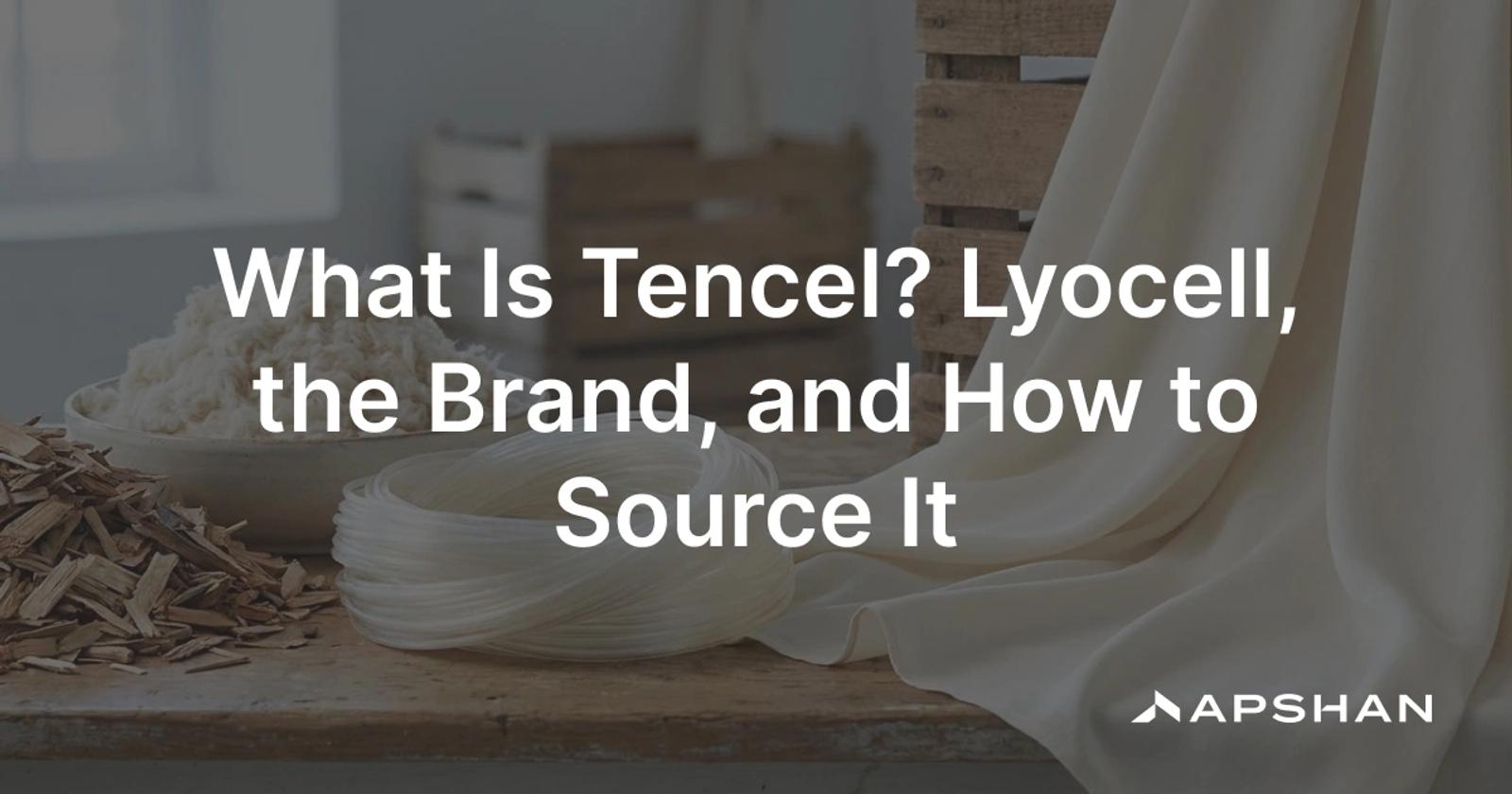
What is Tencel?
Tencel is a brand name, not a type of fabric. It is the trademark Lenzing, an Austrian fibre producer, uses for its lyocell and modal fibres. So when a label says Tencel, it means a specific, certified version of a wider fibre, usually lyocell.
Lyocell itself is a regenerated-cellulose fibre made from wood pulp, most often eucalyptus, beech, or spruce. Like viscose and modal, it starts from a plant but is chemically dissolved and re-formed into fibre, which makes it a man-made cellulosic. It is not natural like cotton, and it is not synthetic like polyester; it sits in between, and it is the newest and cleanest of the three main cellulosics.
This is where a lot of marketing goes wrong. Tencel is often called a natural fabric, but it is not: the raw cellulose is genuinely renewable, yet the fibre is manufactured. The accurate description is semi-synthetic or man-made cellulosic, the same family as viscose and modal and a close cousin of recycled cotton in how a brand weighs it up.
Tencel vs lyocell: brand versus fibre
The cleanest way to hold it in your head: all Tencel is lyocell or modal, but not all lyocell is Tencel. Lyocell is the generic fibre category, defined under the ISO 2076 fibre-naming standard. Tencel is Lenzing's branded lyocell, sold with chain-of-custody and certification behind it.
- Lyocell: the generic fibre, made by anyone running the solvent-spinning process. Quality and sourcing vary by producer, and a garment can be pure lyocell without being Tencel.
- Tencel: Lenzing's branded lyocell (and modal), backed by certified wood sourcing, audit documentation, and, for lyocell, the EU Ecolabel. Under the Tencel name Lenzing sells Tencel Lyocell, Tencel Modal, and Tencel Lyocell Filament.
For a brand, the distinction is not pedantry. Generic lyocell can be excellent or mediocre depending on the mill; Tencel comes with the paperwork to back a sustainability claim. That paperwork is exactly what a green claim has to rest on.
Lenzing also states that its Tencel lyocell and modal are made with at least 50 percent less carbon emissions and water than generic lyocell and modal, a claim it grounds in life-cycle assessment. Whether or not a brand leans on that figure, the point stands: the brand name is a proxy for a documented process, while generic lyocell is only as good as its unnamed producer.
How Tencel and lyocell are made
Lyocell's whole reputation comes from its process, and it is worth understanding because it is what separates it from viscose. It runs as a closed loop.
- Dissolving pulp: wood is chipped and purified into dissolving pulp, ideally from certified forests, which is the same starting point as viscose and modal.
- Direct dissolution: the pulp is dissolved directly in a non-toxic organic solvent called NMMO, with no carbon disulfide and no chemical derivatisation, which is the step that makes conventional viscose polluting.
- Spinning: the cellulose solution, or dope, is extruded into fibre and washed, and the water and solvent are captured for reuse rather than discharged as waste.
- Closed-loop recovery: more than 99 percent of the NMMO solvent, around 99.5 percent at a well-run plant, is recovered and reused, so very little leaves the system.
That closed loop, plus a non-toxic solvent, is why lyocell is treated as the cleanest cellulosic to make. It is the same idea as viscose (dissolve cellulose, re-form it) done with better chemistry.
The process is not new. Lyocell was developed from the 1970s and first sold commercially by the British company Courtaulds under the Tencel name in 1992, landing first in denim. Lenzing acquired the Tencel brand in 2004 and now runs it as its premium cellulosic line, which is why Tencel and Lenzing are used almost interchangeably today even though the fibre itself is generic.
Tencel properties: strengths and the one weakness
Lyocell behaves like a stronger, more technical viscose. It keeps the soft hand and drape but fixes the wet-strength problem, with one processing caveat to know.
- Soft and smooth: lyocell has a fluid drape and a smooth, cool hand that reads close to silk, which is why it is popular in dresses, shirting, and premium denim.
- Moisture-wicking: its fibre structure absorbs and releases moisture efficiently, so it breathes well, feels cool against the skin, and suits activewear and bedding where sweat management is the selling point.
- Strong when wet: unlike viscose, lyocell keeps most of its strength when wet, so it launders far better and resists the stretching and tearing that plague viscose in the wash.
- Gentle and low-shrink: it is smooth enough to suit sensitive skin, resists wrinkling, holds colour well, and shrinks less than viscose when it is handled and finished correctly.
- The fibrillation caveat: raw lyocell can fibrillate, forming tiny surface fibrils that look like fuzz or pilling when it is rubbed wet. Good finishing controls this, which is why the finish, not just the fibre, matters on a spec.
Because fibrillation shows up as surface change, it is worth pairing a lyocell fabric with pilling and colourfastness checks, and writing the care label to match how the finished fabric actually behaves.
What Tencel is used for
Lyocell spans apparel and home textiles, and it leans premium because it costs more than viscose. It shows up wherever softness plus durability is worth paying for, and its cool, moisture-managing hand has made it a default upgrade fibre for brands wanting a cleaner story without giving up feel.
- Apparel: dresses, blouses, shirting, and trousers, where a soft drape that also washes well is the draw, and where viscose's wet weakness would be a liability.
- Denim: Tencel lyocell was launched in denim and is still widely blended into it for a softer, more fluid jean.
- Activewear and underwear: its moisture management and softness suit next-to-skin pieces, often blended with elastane for stretch, where the fibre's cool hand is a genuine performance feature.
- Bedding: lyocell sheets are marketed as cool and moisture-wicking, and bedding is now one of the single biggest end uses driving demand for the fibre.
- Blends: lyocell is often blended with cotton, wool, or synthetics to lend softness, strength, and a cleaner sustainability story to the mix, though any synthetic in the blend cancels the biodegradability the pure fibre offers.
Is Tencel sustainable? The honest version
Lyocell is one of the better mainstream fibre choices, but the honest answer is conditional, not automatic. It is a strong option precisely because its impact is designed out at the process and sourcing stages rather than offset afterwards. Three things carry it, and one caveat keeps it grounded.
- The closed loop: the recovered, non-toxic solvent means production is far cleaner than conventional viscose, the fibre's biggest single advantage.
- The wood: Tencel wood is sourced to FSC or PEFC certification under Lenzing's wood policy, which addresses the deforestation risk that dogs cellulosics, since every cellulosic ultimately comes from trees; generic lyocell may or may not do the same, and that gap is the buyer's to close.
- The end of life: pure lyocell is certified biodegradable and compostable, so at end of life it breaks down in a way recycled polyester does not, though blends lose that property.
- The caveat: it is still an industrial, energy-using process, and it is not natural. Calling Tencel natural, or treating generic lyocell as automatically green, is where greenwashing creeps in.
Put next to its neighbours, lyocell sits at the top of the cellulosic family on process: cleaner than conventional viscose, and stronger and lower-shrink than either viscose or modal. Modal, also sold under the Tencel brand, is a high-wet-modulus fibre made by a modified viscose process, softer than standard viscose but not made in the same fully closed loop as lyocell. So Tencel Lyocell and Tencel Modal are not the same fibre or the same footprint, even under one brand.
How brands source and spec Tencel
On a tech pack, the choice is not just lyocell yes or no, it is which lyocell and with what proof. The fibre's sustainability story is only as strong as the documentation behind it, so a usable spec pins that down rather than trusting a fibre name on a swatch card.
- Verify the claim: if the hangtag will say Tencel, use licensed Tencel fibre with Lenzing's certification, not generic lyocell relabelled, so the green claims hold up under scrutiny.
- Check the wood: confirm FSC or PEFC certified pulp as part of a sustainable sourcing decision, especially for generic lyocell where sourcing is not guaranteed.
- Control fibrillation: specify the finish and test for surface change, because an unfinished lyocell can fuzz and pill in wear and wash.
- Set the blend and care: decide the blend deliberately, since blending changes both performance and the biodegradability claim, and reproduce the care and quality specs across textile manufacturing for the whole run.
Knowing which cellulosic, which brand, and which certification fit a given garment is the fashion-native detail Apshan's Nari knowledge graph answers, cited to source, inside the AI assistant your team already uses. Request access.