
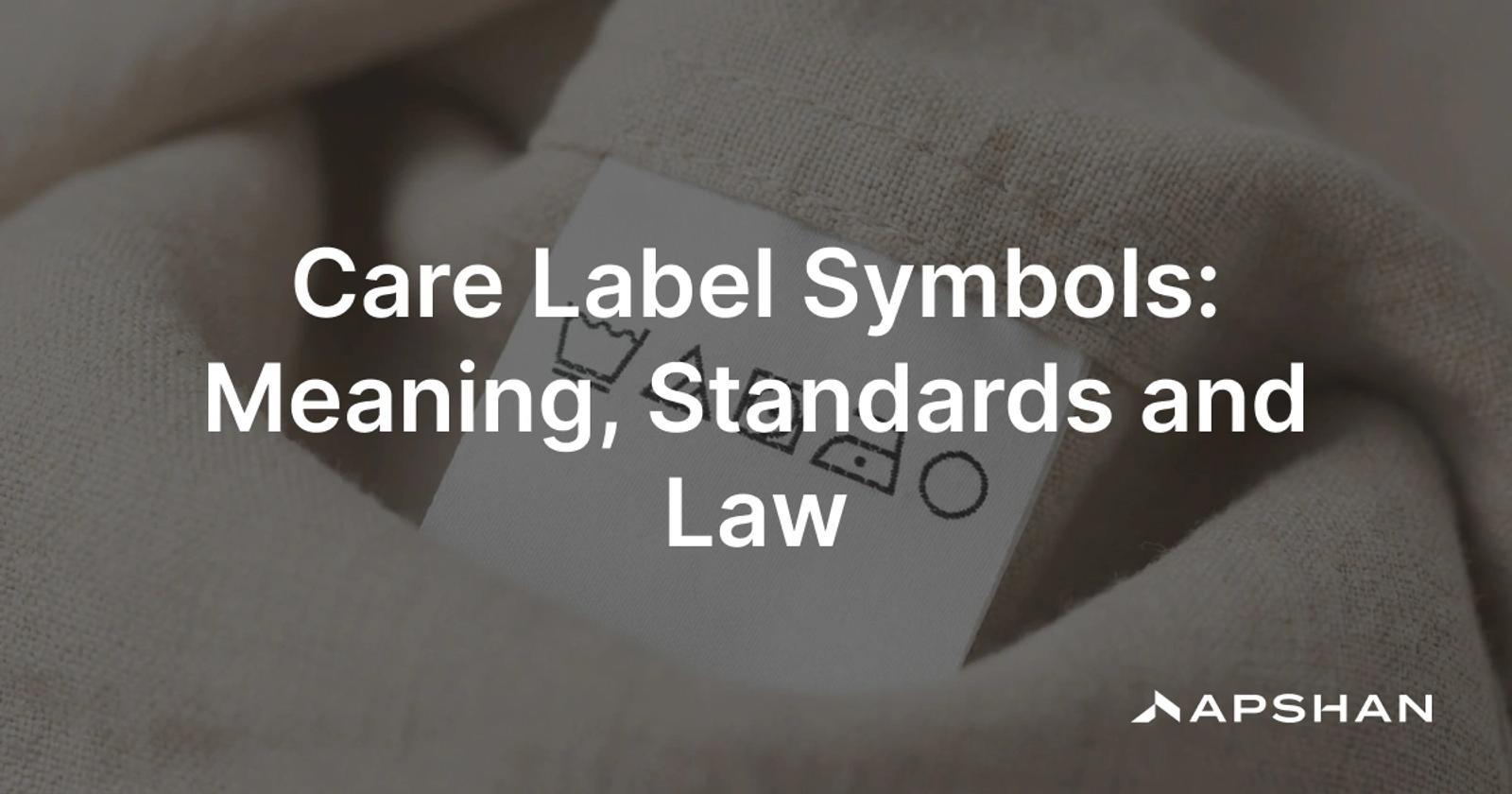
Every garment carries a small row of pictograms that tells its owner how to wash it, and its maker which rules it followed. Care label symbols look universal, but they are not: there are two main systems, they mean slightly different things, and in one major market getting them wrong is against the law.
This guide explains what care label symbols mean, the two standards behind them (GINETEX/ISO 3758 and ASTM), where care labelling is legally required, and how a brand gets the label right as part of the tech pack.
What are care label symbols?
Care label symbols are standardized pictograms that show the harshest treatment a textile can safely take without damage: how to wash it, whether to bleach it, how to dry it, how to iron it, and how it can be professionally cleaned. They appear on the care label sewn into a garment.
The key idea, set by the ISO 3758 standard, is that the symbols show the maximum permitted treatment, not a recommendation. A 40C wash symbol means do not exceed 40C; it does not mean you must wash at 40C. For a brand, that defines a safe boundary, not a preference.
Why does the care label matter?
A care label is small, but it does real work. It protects the garment from being ruined by the wrong wash, protects the customer from disappointment, and protects the brand from returns and, in some markets, penalties.
- Consumer protection: the label is often the only cleaning guidance a customer gets, so a wrong instruction can destroy a garment on its first wash.
- Brand liability: a garment that shrinks, bleeds or falls apart when washed as instructed is the brand's fault, driving returns, refunds and complaints.
- Returns and reputation: laundry damage is a common, avoidable reason for returns and poor reviews, so the label is quietly part of the product's quality story.
- Legal compliance: in the US, a missing or inaccurate care label breaks the FTC rule, so getting it right is a compliance requirement, not a nicety.
The five basic care symbols
There are five basic symbols, always shown in the same order: washing, bleaching, drying, ironing and professional textile care. Each can carry extra marks, dots, bars, lines or a cross, that refine or forbid the treatment.
- Washtub (washing): shows the maximum wash temperature, as a number in Celsius under GINETEX/ISO or as dots under the US system; a hand means hand wash only, and a cross means do not wash.
- Triangle (bleaching): a plain triangle allows any bleach, two diagonal lines allow only non-chlorine (oxygen) bleach, and a crossed triangle means do not bleach.
- Square (drying): a circle inside the square means tumble dry, with dots for heat (one for low, two for normal under the ISO system); lines inside the square mean natural drying, such as line dry, dry flat or drip dry.
- Iron (ironing): the dots set the maximum temperature, one dot for low (around 110C), two for medium (150C), three for high (200C); a cross means do not iron.
- Circle (professional care): a circle covers dry cleaning and wet cleaning, with a letter (P, F or W) telling the cleaner which process, bars for how gentle, and a cross to forbid it.
- Bars and crosses: a bar under a symbol means reduce the mechanical action, a gentler cycle; a second bar means gentler still; a cross through any symbol means that treatment is not allowed.
Read left to right, a typical label tells a short story: wash at 30C on a gentle cycle, do not bleach, tumble dry low, iron warm, do not dry clean. The order never changes, so once the sequence is familiar, any label can be read at a glance.
GINETEX/ISO 3758 vs the US system
The symbols are not truly global. Most of the world, including the EU, the UK and China, uses the GINETEX system, embodied in the ISO 3758 standard. The US, Japan and South Korea use their own. For a brand, that means one label does not fit every market.
- GINETEX / ISO 3758: the international system, owned by GINETEX and written into ISO 3758; the five symbols are registered trademarks, and using them requires a licence through the national committee.
- ASTM D5489 (United States): the US care-symbol guide, referenced by the FTC rule; the symbols look similar but are a separate, legally recognized set.
- They are not interchangeable: US law does not permit the ISO/GINETEX symbols; only ASTM D5489 symbols satisfy the US rule, so a European label cannot simply be shipped across the Atlantic.
The split is historical. GINETEX and ISO agreed decades ago that ISO would embed the GINETEX symbols in ISO 3758 while GINETEX kept ownership of the marks, which is why the international symbols and the standard line up, and why the US, which went its own way with ASTM, stands apart.
Are care labels legally required?
It depends entirely on the market, and this is where brands get caught out. In the United States, care labelling is legally mandatory; in the European Union, it is not.
- United States, mandatory: the FTC Care Labeling Rule (16 CFR Part 423) requires manufacturers and importers to attach a permanent care label with at least a washing and a drying method, using approved terms or ASTM symbols.
- European Union, voluntary: Regulation (EU) 1007/2011 makes only the fibre composition mandatory; care instructions are industry standard but not required by law, and the coming Digital Product Passport may change what has to be disclosed.
- Everywhere else varies: GINETEX/ISO symbols are recognized in most countries; Japan and South Korea run their own systems, so a global brand maps care labelling market by market, not once.
The practical upshot is that care labelling is where a global range quietly fragments. A single product sold into the US, the EU and Asia may need the same wash instruction expressed in different ways, on different compliant labels, to satisfy different regimes. Planning for that early is far cheaper than reprinting labels after a shipment is rejected at the border.
How a brand gets the care label right
For a brand, the care label is a compliance and quality task, not an afterthought printed at the end. Getting it wrong risks penalties in the US and ruined garments everywhere.
- Derive the care from testing, not guesswork: base the instructions on the fabric supplier's data and wash testing, so the symbols reflect what the garment can actually survive.
- Match the symbol system to the market: ASTM for the US, GINETEX/ISO 3758 for the EU and most of the world, and license the GINETEX marks where you use them.
- State the harshest safe treatment: the symbols set the safe maximum, so err toward the gentler instruction if in doubt; a garment ruined by following its own label is the brand's problem.
- Put it in the tech pack: specify the exact care instruction and symbol set in the tech pack, so the label supplier and factory print the right label, consistently, on every unit.
Care labelling is one of many market-by-market rules a brand tracks, alongside fibre content, chemical compliance and sustainability claims. Apshan structures that regulatory and sourcing knowledge, cited to source, so nothing is missed. Request access or see the plans and pricing.