
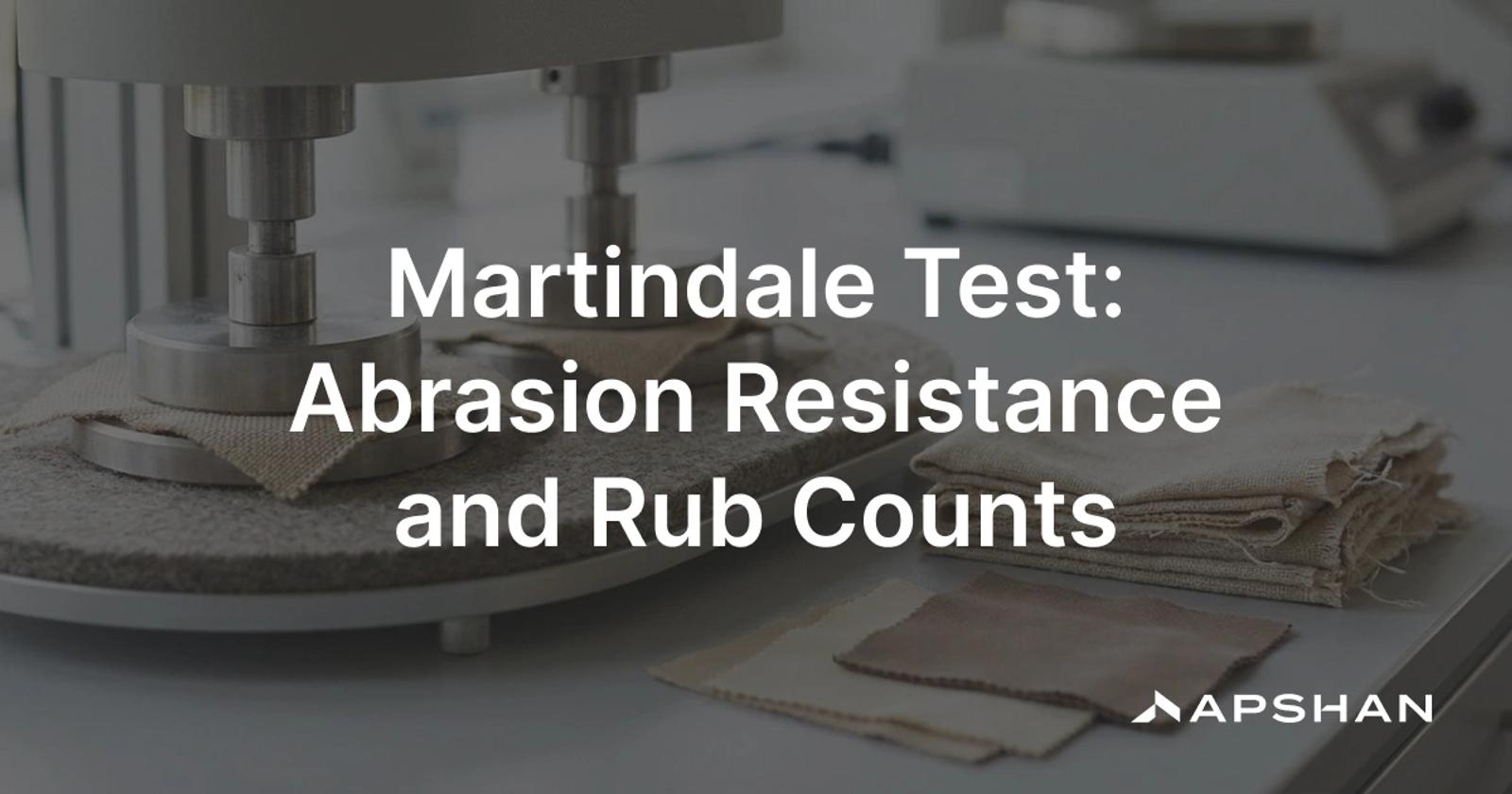
Almost every garment and upholstered seat wears out the same way: rubbing. Elbows, cuffs, seat cushions, backpack straps. The Martindale test puts a number on how long a fabric survives that rubbing, and it is one of the core durability checks a fabric passes before it goes into production.
This guide explains what the Martindale test measures, how the rub count works, the standards behind it, how it compares to Wyzenbeek, and how to spec it in textile manufacturing and sourcing.
What is the Martindale test?
The Martindale test measures a fabric's resistance to abrasion, the wear that comes from repeated rubbing. A flat fabric sample is rubbed against a standard abradant, usually a worsted-wool cloth, in a continuously changing figure-eight motion, until the fabric shows a defined sign of failure. The number of rubs it survives is its Martindale rating.
The figure-eight path, technically a Lissajous figure, matters. It rubs the fabric in every direction rather than back and forth along one line, which better mimics how real wear happens from all angles. The test runs on a Martindale abrasion machine, with several samples rubbed at once under a set pressure.
- The load: samples are rubbed under a standard weight, commonly about 9 kPa for apparel and 12 kPa for upholstery, so heavier-use fabrics are tested under more pressure.
Why does abrasion resistance matter?
Abrasion is how most fabrics actually fail. Not in a dramatic tear, but slowly, as rubbing thins the surface, breaks yarns and wears through at the points of contact. The Martindale count is a way to see that coming before a customer ever does.
- Product lifespan: abrasion resistance is a direct proxy for how long a garment or seat keeps looking acceptable, the difference between a product worn for years and one retired in a season.
- Cost per wear and returns: a fabric that wears through early drives returns, warranty claims and complaints; specifying the right abrasion level is far cheaper than fixing a durability failure in the field.
- Fit for purpose: the same fabric can be perfect for a lining and useless for a chair seat; the rub count is how a buyer checks a fabric matches the job before committing to bulk.
- Sustainability: a longer-lasting fabric means fewer replacements, so abrasion resistance is quietly one of the most practical levers behind a longer product life.
How the rub count works
The rub count, sometimes called the Martindale count, is simply the number of rubs, or cycles, the fabric endures before it reaches the test end-point. A 40,000-rub fabric survived twice as many cycles as a 20,000-rub one. Higher means more abrasion-resistant.
The abradant is standardized too: a specific worsted-wool fabric, replaced regularly so it does not glaze and stop cutting. Both the abradant and the sample are conditioned first, because the result is only reproducible if every lab runs it on the same materials, at the same pressure.
- The end-point (ISO 12947-2): the most common method stops when the specimen breaks down, defined as two threads breaking or a hole appearing, checked by inspection at set intervals.
- Mass loss and appearance (ISO 12947-3 and -4): alternative methods measure the weight lost, or the change in appearance, after a fixed number of rubs rather than running all the way to breakdown.
- It is abrasion only: a high rub count says the surface resists wear; it does not measure pilling, tearing, seam strength or colorfastness, which are separate tests.
Martindale rub-count benchmarks by use
There is no single pass mark; the target rub count depends on how hard the fabric will be used. The bands below are typical, and the numbers rise steeply from apparel to contract furniture.
- General apparel: roughly 10,000 to 20,000 rubs for everyday garments that are not under constant friction.
- Hardwearing garments: around 20,000 to 40,000 or more for workwear, uniforms, outerwear and denim, which take heavy, repeated rubbing.
- Domestic upholstery: commonly 10,000 to 15,000 rubs for light use, 15,000 to 25,000 for general, and 25,000 to 30,000 for heavy domestic.
- Contract and commercial: 30,000 rubs and up, with the ACT standard setting 40,000 Martindale rubs for heavy-duty contract upholstery.
Two caveats. These bands vary between standards and brands, so a spec should always state the target explicitly. And beyond roughly 40,000 rubs, a higher number does not reliably mean a longer life in practice: construction, finish and fiber start to matter more than the count.
Martindale vs Wyzenbeek
Martindale and Wyzenbeek are the two main abrasion tests, and they are not interchangeable. Martindale (ISO 12947) rubs in a figure-eight and counts rubs; Wyzenbeek (ASTM D4157) rubs back and forth along the warp and weft and counts double rubs. A double rub is one full back-and-forth pass.
- Martindale: an oscillating figure-eight motion, common in Europe and internationally; the result is a number of rubs.
- Wyzenbeek: a straight back-and-forth motion along the warp and weft, common in North America; the result is a number of double rubs.
- You cannot convert between them: a Martindale figure and a Wyzenbeek figure are not comparable, and the common rule that Martindale runs about a third higher is unreliable, so always ask which test a rating comes from.
Martindale and pilling
The same Martindale machine also runs a pilling test, but it is a different assessment. Abrasion asks how long until the fabric wears through; pilling asks how quickly small balls of tangled fiber form on the surface. Pilling by the modified Martindale method follows ISO 12945-2 and is graded 1 to 5, where 5 is no pilling and 1 is severe.
So a fabric can post an excellent abrasion rub count and still pill badly, or the reverse. Where surface appearance matters, as it does for knitwear and jersey, the pilling grade is the number to watch, not the abrasion count.
For sourcing, that means running both where it counts: the abrasion count for structural wear, the pilling grade for the look. A jersey tee that survives 20,000 rubs but pills after a few washes will still be judged worn out by the person wearing it.
Using Martindale in a sourcing spec
For a brand, the Martindale rating is a durability lever set against how the product will actually be used, not a bigger-is-better contest.
- Match the count to the wear: a summer blouse does not need workwear-grade abrasion; over-specifying buys a stiffer, costlier fabric for no real benefit.
- State the standard and target: name ISO 12947-2 (or ASTM D4966) and the rub count in the tech pack, so the mill and the lab test the same way; a bare durable is not a spec.
- Read it with the other tests: abrasion sits alongside pilling, tensile strength and seam slippage in the wider quality-control panel; no single number proves a fabric is fit for production.
It also pays to be specific in the purchase order. Asking a mill for a Martindale figure without naming the end-point method, the pressure and the standard invites a number that looks impressive but was measured under easier conditions than your product actually needs.
Choosing the right abrasion target, and reading it against fiber, construction and end use, is a sourcing judgment. Apshan structures that fashion knowledge, cited to source, so the call is informed rather than guessed. Request access or see the plans and pricing.