
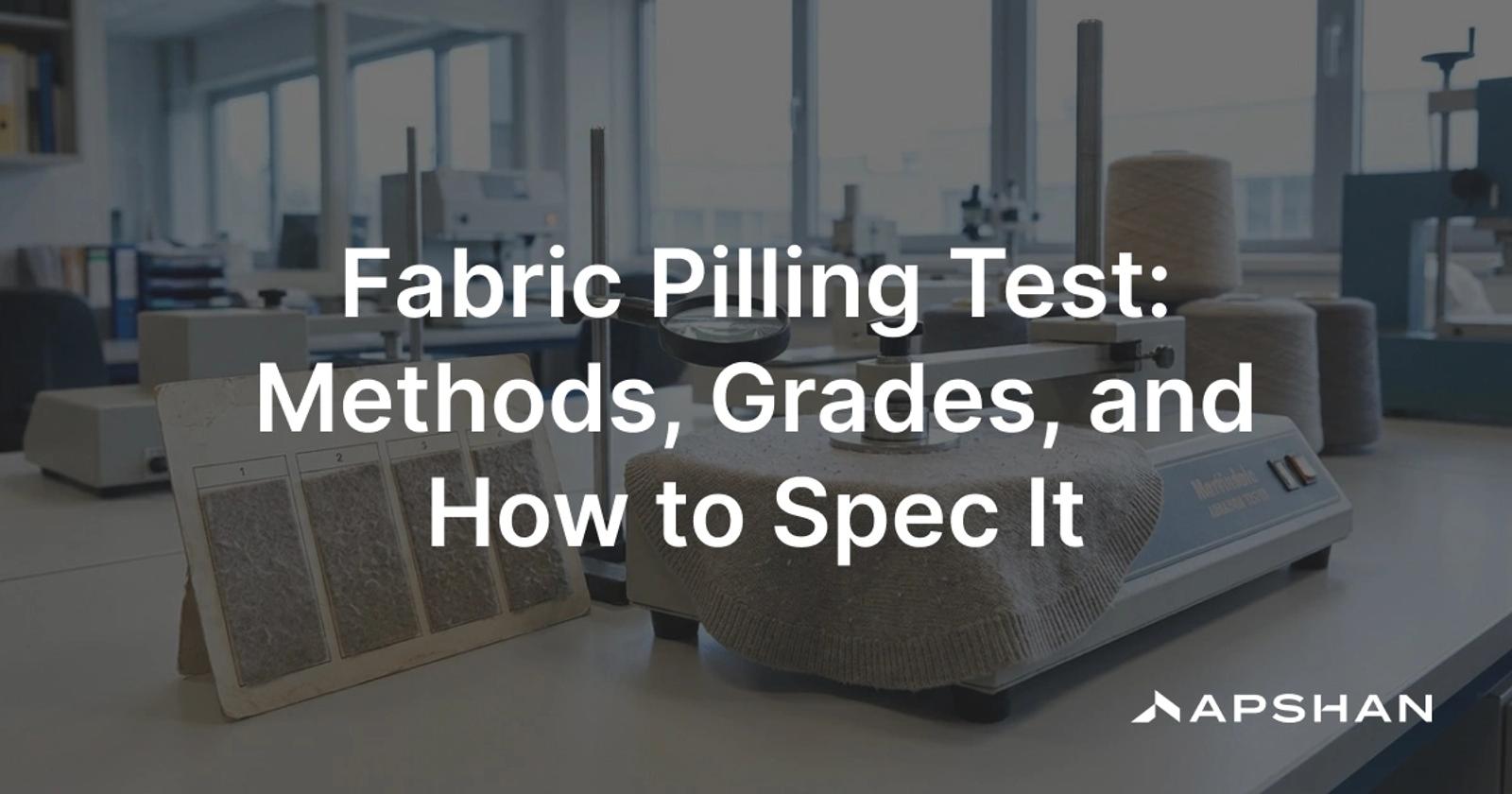
What is a fabric pilling test?
A fabric pilling test measures how readily a fabric pills. A lab abrades or tumbles a swatch for a set number of cycles, then a trained grader compares the worn surface to reference photographs and assigns a grade from 5 (no pilling) to 1 (severe pilling).
Pilling is one of the most common complaints after a garment is bought, so brands test for it before a bulk run rather than after the returns come in. The test turns a vague worry into a single number that a mill, a third-party lab, and a buyer can all agree on and hold each other to.
It sits alongside abrasion and colorfastness as a core fabric-quality check, and a pass grade written into the spec is what makes it enforceable across a production run.
What is pilling, and why fabrics pill
Pilling is the formation of small balls of tangled fibre, called pills, on a fabric surface. As the cloth is rubbed in wear, loose surface fibres work loose, tangle together, and ball up instead of shedding. A few things decide how badly a fabric pills.
- Fibre type: synthetics and blends often pill worse than pure natural fibres, because strong fibres like polyester hold the pills onto the surface instead of letting them break away.
- Yarn and twist: low-twist, short-staple, and hairy yarns shed more loose fibre, so they pill faster than smooth, high-twist, long-staple or filament yarns.
- Fabric structure: loose, open knits pill more than tight, dense wovens, because there is more free fibre at the surface and more room for it to move.
- Finish: surface finishes like singeing, shearing, and biopolishing burn or cut away surface fuzz before the fabric ships, which lowers how much it can pill later.
Pilling runs through a life cycle: surface fibres first fuzz up, then tangle into pills, and on some fabrics the pills eventually rub off while on others they stay put and grow. Washing and tumble drying speed the whole cycle up, which is why a fabric can look fine in the shop and pill after the first few washes.
Pilling is not always a defect, since it can come from the fabric rubbing against an outside fibre source such as a bag strap or a car seat. But it is a real risk to the finished look, so a test quantifies it before it becomes a returns problem rather than leaving it to chance.
The main pilling test methods
Four methods dominate, and they differ in how they wear the surface. The right one follows the fabric: pressure-based tests suit wovens, tumbling tests suit knits.
- Modified Martindale (ISO 12945-2, ASTM D4970): a circular swatch is rubbed against itself or a wool abradant in a figure-of-eight motion under a set load, then graded at cycle stages such as 125, 500, 2000, and 7000. Best for wovens and upholstery, where the load mimics real pressure. It runs on the same machine as the Martindale abrasion test, set up differently.
- Pilling box, or ICI (ISO 12945-1): swatches are mounted on polyurethane tubes and tumbled inside a cork-lined box, so the fabric pills by random tumbling rather than pressure. It is the preferred method for knits, sweaters, and loose structures.
- Random tumble (ISO 12945-3, ASTM D3512): specimens tumble freely in a lined chamber driven by an impeller, often with a little grey cotton added, for a set time. It applies to both woven and knitted apparel fabrics.
- Brush and circular methods (ASTM D3511, circular locus): a brush or a nylon-brush-and-abradant head first raises the surface fuzz, then the fabric is pilled and graded. These are niche routes used where the standard tumble or Martindale methods do not suit the fabric.
The methods are not interchangeable, and they can give different grades for the same cloth: a dense woven pills hardest under the loaded Martindale, while a loose knit pills hardest in the free-tumbling box. That is why a result is only meaningful next to the method, the standard, and the cycle count it came from, never as a bare number.
The pilling grade scale, 1 to 5
Whatever the method, the result is the same 1 to 5 grade, read by comparing the tested swatch to a set of standard photographs. Grade 5 is a clean surface; grade 1 is heavy pilling over the whole face.
- Grade 5: no change, no visible fuzzing, pilling, or matting.
- Grade 4: slight surface fuzzing, with pills at most partially formed.
- Grade 3: moderate fuzzing and pilling, visible but not dense.
- Grade 2: distinct pilling covering a large part of the surface.
- Grade 1: dense fuzzing or severe pilling covering the whole surface.
Graders assess several specimens under controlled lighting, and half grades such as 3.5 are allowed, so the reported number is an average rounded to the nearest half grade. The visual assessment itself is set out in ISO 12945-4, which keeps different labs reading the same swatch the same way.
Grade and cycle count move together. A fabric graded at 2000 rubs may sit at grade 4, then slip to grade 3 by 7000, so the number is only half the story without the stage it was read at. A good report lists the grade at each cycle stage, not just the final one, so you can see how fast the surface breaks down.
What pilling grade should you accept?
There is no universal pass mark. The grade you accept depends on the product and how hard it is worn, so set it against the end use rather than picking a number in the abstract.
- Everyday apparel and knitwear: a minimum of grade 3 to 4 is commonly required, since anything below 3 will pill visibly in normal wear and wash cycles.
- Premium and brushed fabrics: grade 4 to 5, where a clean, unpilled surface is part of what the customer is paying for.
- Upholstery and contract fabrics: tested by the Martindale method at high cycles, held to a firm bar because the fabric is rubbed constantly under body weight.
Agree the method and the pass grade with the mill before bulk, not after. A grade on its own means little; grade 4 by the pilling box is not the same claim as grade 4 by Martindale at 7000 rubs, and comparing the two as if they were equal is a common mistake.
When a fabric lands a half grade short, you have three moves: accept it for a lower-wear style, push the mill to change the yarn or finish and retest, or drop the fabric. Deciding that up front, against the price and the end use, is faster than arguing over a borderline report once the bulk is already woven.
How to spec a fabric pilling test in a tech pack
A usable pilling spec names four things, so the mill, the lab, and the buyer all test the same way and read the result the same way.
- The method and standard: Martindale (ISO 12945-2), pilling box (ISO 12945-1), or random tumble (ISO 12945-3), matched to the fabric, and written into the tech pack so it is not left to the mill to choose.
- The cycle count or duration: the number of rubs or the tumble time, such as 2000 or 7000 Martindale cycles, so results compare run to run and lab to lab.
- The minimum pass grade: the number the lab reports against, such as grade 4 minimum, tied to the end use of the garment.
- Where it sits in QC: a lab test on the approved fabric and on bulk before cutting, feeding the AQL inspection plan and reproduced across textile manufacturing for the whole order.
Pilling test vs abrasion test
The pilling test and the abrasion test often run on the same Martindale machine, but they measure different things. The pilling test rubs a fabric against itself or a wool abradant under a light load and grades the balls of fibre that form. The abrasion test rubs the fabric against a standard abradant under more load and measures how far it wears before it breaks down.
To cut pilling risk before it reaches a test at all, work it at the fabric-development stage. Favour longer-staple or filament yarns, higher twist, and tighter structures, and add a surface finish such as singeing, shearing, or biopolishing that clears loose fibre before the cloth ships. Small changes in yarn and finish move a grade more cheaply than reworking a whole fabric later.
Then test early and test twice: once on the approved lab-dip or hanger, so a weak fabric is caught before the order is placed, and again on the first bulk, so a substitution or a process drift at the mill does not slip through. Caught at the swatch stage it is a fabric choice; caught after cutting it is a write-off.
Knowing which pilling method, standard, and pass grade fit a given fabric is exactly the fashion-native detail Apshan's Nari knowledge graph answers, cited to source, inside the AI assistant your team already uses. Request access.