
What is seam slippage?
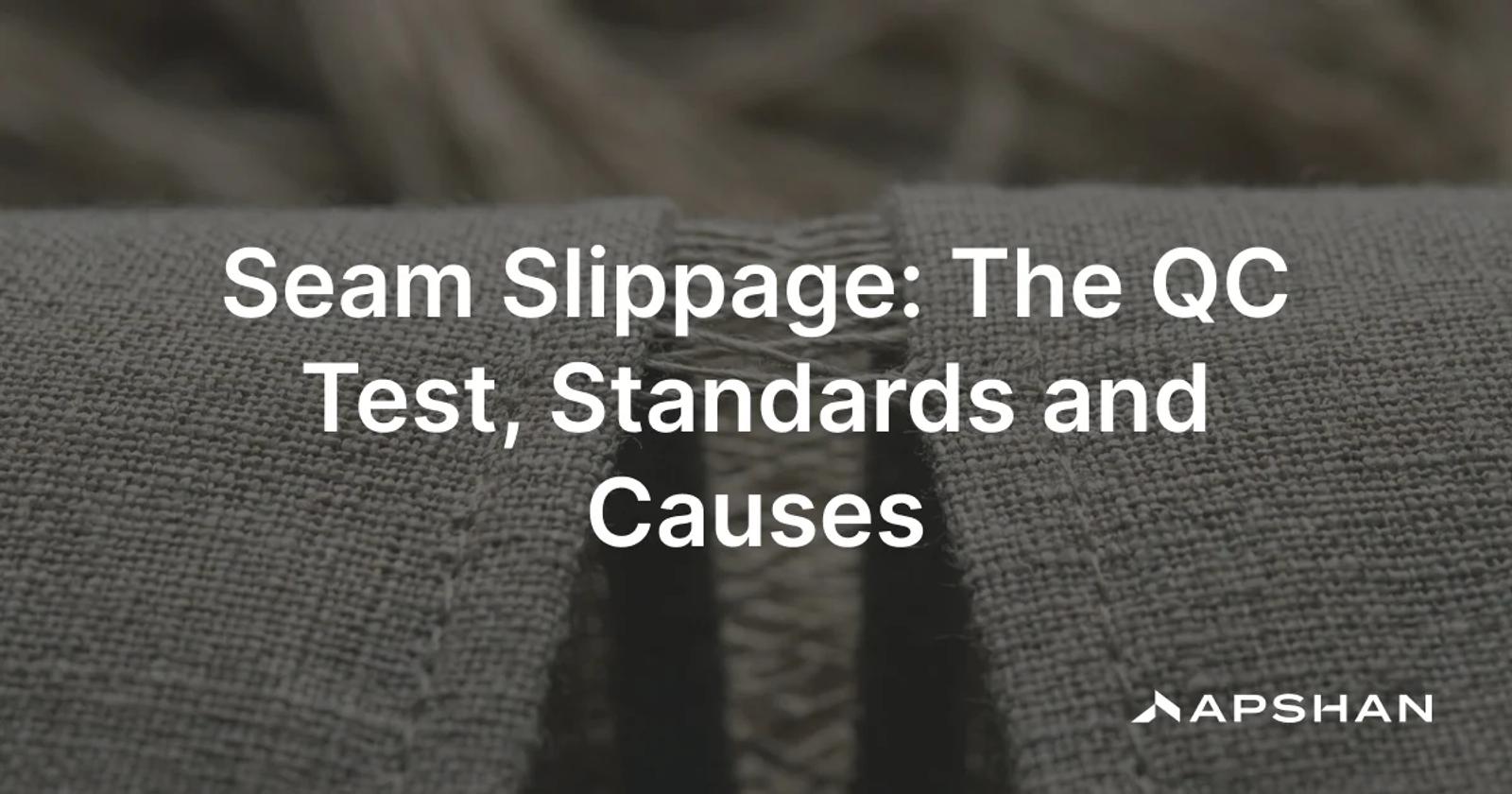
Seam slippage is when the yarns of a woven fabric slide sideways and pull apart at a stitched seam under load, opening a gap along the seam line. The sewing thread does not break; the fabric yarns themselves move, so the seam gapes even though the stitching is intact.
The term does double duty. It names the defect you see in a finished garment or sofa, a seam that has opened into a visible gap, and it names the laboratory test that predicts it, so a fabric can be accepted or rejected before it ever reaches production.
- It is a woven-fabric problem, and one of the core textile QC tests, measured in both the warp and the weft direction because a fabric can resist slippage one way and fail the other.
That distinction, yarns moving rather than thread breaking, is what separates seam slippage from seam strength, and it is why the two are tested and specified differently. More on that below.
Why seam slippage matters in production
A fabric can pass abrasion, colour and shrinkage tests and still fail in use if its seams open up. Seam slippage shows at the exact points a garment or cover is under the most tension, which is where the wearer notices it first.
- It appears at stress points: fitted waistbands, side seams, armholes and crotch seams on close-fitting garments, and seat cushions, armrests and tight-upholstered corners on furniture. The tighter the fit or the heavier the load, the sooner it opens.
- It is usually not repairable: once the yarns have shifted, restitching the same seam rarely holds, because the fabric structure at the seam is already disturbed. A garment gets returned; upholstery has to be recovered.
- It drives returns and rejects: for a brand it is a warranty and reputation cost, which is why buyers put a seam-slippage clause in the fabric spec and test to it before bulk, rather than discovering it in customer complaints.
Because the failure is in the fabric and the making, not the thread, catching it is a material-selection and construction decision. The test exists to make that decision on evidence rather than on a supplier's word.
How the seam slippage test works
The test sews a standard seam into the fabric, then pulls it apart on a tensile machine and watches the seam open. It is run on a constant-rate-of-extension (CRE) tester, the same class of machine used for tensile and seam-strength tests, and it is done separately in the warp and the weft.
A seamed specimen and a matching unseamed specimen are gripped and extended. Comparing the two load-extension curves isolates how much of the opening is the seam slipping rather than the fabric simply stretching. There are two ways to read the result, and they are the basis of the two main standards.
- Fixed load, measure the opening: apply a load chosen for the end use, hold it, and measure how wide the seam has opened. A wider opening means worse slippage. This is how most apparel and upholstery pass or fail decisions are made.
- Fixed opening, measure the force: extend the seam until it opens a set amount, commonly 6mm, and record the force it took to get there. A higher force means better resistance. This gives a single strength-style number per direction.
Either way the fabric is tested in both directions, because slippage is driven by how tightly one set of yarns grips the other, and that grip is rarely equal in warp and weft.
The standards: ISO 13936 and ASTM
Two families of standard cover seam slippage. Naming the exact one in a spec matters, because the method changes what number you get and whether it even applies to your fabric.
- ISO 13936-1, fixed seam opening method: extend the seam to a fixed opening (typically 6mm) and record the force. It is written for woven apparel and furnishing fabrics and is explicitly not for stretch fabrics.
- ISO 13936-2, fixed load method: apply a fixed load set by end use and measure the resulting seam opening. Its scope covers all apparel and upholstery woven fabrics, including stretch fabrics with elastomeric yarn, so it is the more broadly usable of the two.
- ISO 13936-3, needle clamp method: a variant that grips the fabric on a row of needles rather than a sewn seam, used where a sewn specimen is impractical.
- ASTM D1683, failure in sewn seams of woven fabrics: the current North American method. It applies force perpendicular to a sewn seam and reports seam strength, seam efficiency and slippage together, and it is run alongside the grab tensile test (ASTM D5034). The older dedicated yarn-slippage method, ASTM D434, was withdrawn in 2004, so ASTM now assesses slippage within D1683.
In practice a global brand names one method, one direction requirement, and one threshold in its fabric standard, so every mill and lab reports a comparable number.
What counts as a pass?
There is no single universal pass mark; the threshold is set by the end use and agreed between buyer and supplier. What is common is the reference point the number is measured against.
- The 6mm benchmark: a maximum seam opening of about 6mm at a specified load is a widely used apparel and upholstery limit, and 6mm is also the opening most often specified when the force is measured instead. A smaller opening, or a higher force to reach 6mm, is a better result.
- The load depends on the product: a lightweight blouse fabric is tested at a lower load than a heavy upholstery or workwear fabric, so a pass on one is not a pass on the other. The spec has to state the load, not just the opening.
- The buyer sets the bar: standards define the method; the brand or retailer sets the accept or reject value in its own fabric standard. Two brands can run the same ISO method and hold different limits.
This is why a bare claim that a fabric passed seam slippage means little without the method, the direction, the load and the limit attached to it.
What causes seam slippage
Seam slippage comes from a combination of the fabric and the way it is sewn. The fabric sets how easily yarns can move; the construction decides how much load is put on them.
- Loose, low-density weave: the biggest driver. When warp and weft are packed loosely, yarns have room to slide past each other, so a low cover factor and a low thread count both raise slippage risk.
- Smooth filament yarns: slick, continuous-filament yarns such as polyester, nylon, acetate and many satins have little inter-yarn friction to hold each other, so they slip more readily than matte, staple-spun yarns. Smooth, lustrous linen behaves the same way.
- Insufficient seam allowance: when the seam sits too close to the cut edge, there is too little fabric beyond the stitch line for the yarns to anchor into, so they pull free of the seam.
- Low stitch density: too few stitches per inch concentrates the load on fewer yarns and lets the fabric shift around a sparse seam. Stitch type and tension matter too.
- The wrong seam for the job: a plain single-needle seam in a high-stress area slips where a stronger, reinforced or double-stitched construction would hold.
How to prevent or reduce it
Most of these are set at design and sourcing, before a stitch is sewn. Each fix maps to one of the causes above.
- Choose a denser fabric: specify a higher thread count and cover factor for the stress areas, or a fabric already proven on the seam-slippage test at your load. A tighter weave is the most durable fix because it removes the root cause.
- Add seam allowance and stitches: widen the seam allowance in high-load seams and raise the stitch density so the load spreads across more yarns and the seam has more fabric to grip.
- Pick the right seam and reinforce it: use a stronger seam construction, a felled or double-stitched seam, and reinforce or tape high-stress seams; overlocking or binding the raw edge helps on loose weaves.
- Manage the slippery yarns: where a smooth filament fabric is a must, compensate with a tighter construction, an interlining or a fusible backing at the seam, and test it rather than assuming it will hold.
- Sample and test before bulk: confirm the real fabric on the real seam at the real load, and pull the sample by a defined acceptance standard so the result represents the lot, not one lucky swatch.
Seam slippage vs seam strength
The two are often confused because both are seam failures pulled on the same kind of machine, but they are different failures with different remedies.
- Seam slippage: the fabric yarns slide apart and the seam gapes; the thread stays whole. It is a fabric-and-construction problem, fixed with a denser weave, more allowance and more stitches.
- Seam strength: the seam ruptures, either the thread breaks or the fabric tears at the stitch line, under enough force. It is measured as breaking force, or as seam efficiency, the seamed strength as a percentage of the unseamed fabric.
A fabric can be strong yet slip, or grip well yet tear, so a full seam spec covers both. ASTM D1683 reports them together, while ISO keeps slippage (13936) and seam strength and colourfastness and abrasion as separate tests in the wider quality panel.
How to spec seam slippage
On a fabric standard or tech pack, seam slippage is a one-line requirement only if every variable is named. Leave one out and the result is not comparable between mills.
- Name the method: state the exact standard and part, ISO 13936-1 or -2, or ASTM D1683, so the mill and lab run the same test and you are not comparing an opening against a force.
- State the load and the direction: give the test load for the end use and require a result in both warp and weft, since a fabric can pass one direction and fail the other.
- Set the limit: the maximum opening (or minimum force) that passes, for example a 6mm maximum opening at the stated load, as your own accept or reject value.
- Tie it to the sampling plan: say how many rolls or garments are pulled and by what inspection standard, so the pass represents the production lot.
Knowing which test, standard and threshold fit a given fabric and product is the fashion-native detail Apshan's Nari knowledge graph answers, cited to source, inside the AI assistant your team already uses. Request access.