
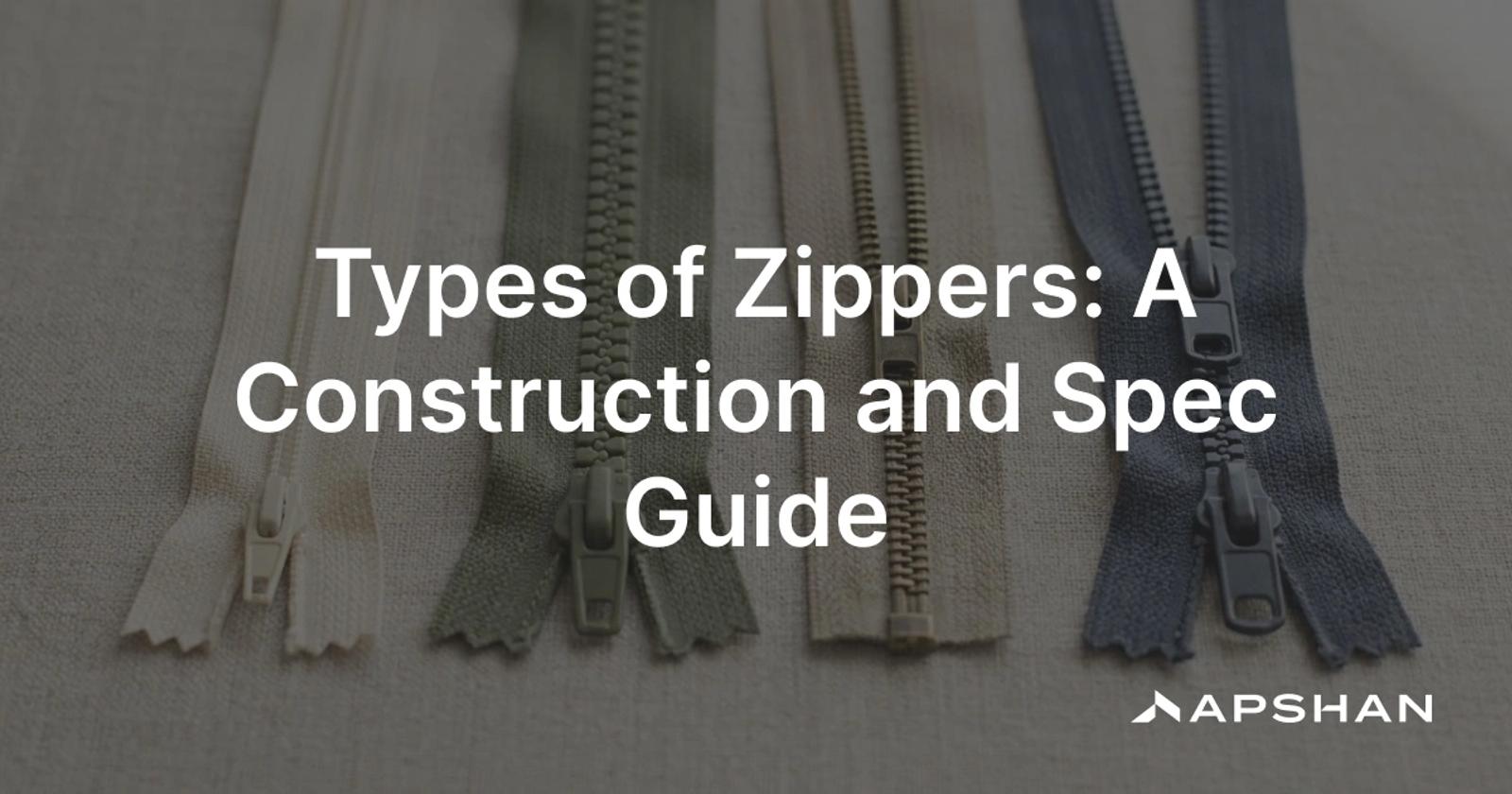
How are zippers classified?
A zipper joins two edges with two rows of interlocking teeth, called elements, that a slider pulls together and apart. Zippers are grouped two ways: by the element (coil, molded plastic, or metal) and by function (closed-end, separating, two-way, or invisible). Both matter to a spec.
The element decides strength, flexibility, and look. The function decides how the zipper opens: whether it splits fully like a jacket, stays joined at the base like a dress, or hides in the seam. A third figure, the size, sets how heavy it is.
The mechanism is the same in every case: the slider meshes the two rows of teeth into a single chain as it moves one way, and separates them again as it moves back. Everything else is a variation on the teeth, the ends, and the slider.
This guide takes element and function as the two axes, then the anatomy, the size system, and how a zipper is specced and chosen.
Zipper types by element
The element is the row of teeth. Three dominate apparel: coil, molded plastic, and metal. Each trades flexibility for strength differently.
- Coil: a continuous nylon or polyester filament coiled and sewn to the tape. Light, flexible, able to bend around curves, and it tends to re-mesh if the teeth are forced apart. The default for dresses, skirts, cushions, sleeping bags, and anything curved, and the base for invisible zippers.
- Molded plastic: individual plastic teeth injection-moulded onto the tape (YKK brands its version VISLON). Rigid, rugged, and UV-stable, it lines up easily when fully separated, which matters for zipping a jacket with cold or gloved hands. The choice for jackets, outerwear, and bags.
- Metal: stamped or die-cast teeth in brass, aluminium, or zinc, clamped onto the tape. The strongest and most abrasion-resistant, but stiff, heavier, and less suited to curves. Used on jeans, workwear, and premium pieces. Metal in skin contact carries a nickel-release rule under REACH.
At the same size, coil is the most flexible, molded the most rugged for its weight, and metal the strongest. Even a large coil zipper bends more easily than a smaller molded one.
Zipper types by function
Function is how the zipper opens, and it follows from the garment. A jacket has to split fully; a dress does not. Compared with buttons or snaps, a zipper closes a whole opening in one pull and seals it evenly, which is why it wins on trousers, fitted dresses, and outerwear.
- Closed-end (non-separating): joined at the base by a bottom stop, so it opens partway but never splits into two. Used on trousers, skirts, dresses, boots, and bags, wherever the opening does not need to come fully apart.
- Separating (open-end): splits completely at the base using an insertion pin and a retainer box, so the two sides come apart. The jacket zipper, also used on vests, hoodies, and coats.
- Two-way: two sliders on one zipper that move independently, so it opens from either end. Separating two-way for long coats and parkas; non-separating two-way for luggage and coveralls.
- Invisible (concealed): a coil zipper built so the teeth sit behind the tape and only the pull shows from the front. Sewn into the seam with a special foot so it disappears, it is the default for dresses and skirts where a clean line matters, and it is harder to repair once damaged.
- Reverse-coil and water-repellent: the coil faces inward for a cleaner look with the tape showing on the front, and a laminated or coated tape (such as YKK AquaGuard) adds water resistance for technical outerwear and bags.
The anatomy of a zipper
Every zipper shares the same parts, and a spec or a repair refers to them by name.
- Tape: the woven fabric bands the elements attach to, sewn into the garment.
- Elements (teeth or coil): the interlocking parts that hold the zipper closed, together called the chain when they are meshed.
- Slider: the piece that meshes and unmeshes the elements as it moves. Sliders can be locking, holding position when the pull is released, or non-locking, moving freely.
- Pull tab: the handle on the slider, and a spec item in its own right for look, grip, and branding.
- Stops: the top stops keep the slider from running off the top; the bottom stop closes a non-separating zipper at the base.
- Insertion pin and retainer box: on a separating zipper, the pin threads into the box to start the closure, replacing the bottom stop.
How zippers are sized: the number system
Zippers are sized by a number, #3, #5, #8, #10, and the number is the approximate width of the closed teeth in millimetres. A #5 zipper has teeth about 5 mm wide. Lower numbers are lighter, higher numbers heavier.
The size is stamped on the back of the slider, often with a letter for the element: C for coil, V for VISLON (molded). Coil and molded zippers usually run #3 to #10, while metal spans a wider #1 to #15. If the slider is missing, you measure the closed teeth in millimetres and round to the nearest standard number.
- Length, measured by type: a closed-end zipper is measured from the top stop to the bottom stop; a separating zipper from the top stop to the retainer box, not the pin. Makers allow a small tolerance, so a millimetre or two is normal.
- Size by garment: #3 for dresses, skirts, and light pieces; #5 as the all-rounder for jackets, hoodies, and bags; #8 and up for heavy outerwear, luggage, and technical gear.
The size also has to match across parts: a #5 slider fits #5 elements, so a replacement slider or pull is ordered to the same number. Mixing sizes is why a repaired zipper often will not close.
Zipper quality and common failures
In production, the zipper is a frequent point of failure and a standard quality check, so the spec is written to guard against the usual problems. A closure that jams or breaks on a returned garment is expensive, and it is almost always one of a few faults.
- Slider wear: the most common failure is a worn slider that no longer pulls the teeth together. It is replaced on its own, matched to the element and size, rather than swapping the whole zipper.
- Split coil and lost teeth: a coil can split open under strain, though it often re-meshes; molded or metal teeth can shear off and do not recover. The element is chosen to match the load.
- Tape and attachment: the tape can fray or pull away from the seam, so the stitching and attachment are checked, and metal elements are tested for nickel release in skin contact.
- The pull test: zippers are cycled open and closed and pull-tested for crosswise strength and slider retention, the same attachment discipline applied to any trim.
How to spec a zipper in a tech pack
On a tech pack, a zipper is a bill-of-materials line. A full spec means the supplier and the factory build the right closure and set it correctly.
- Type and size: coil, molded, or metal, and the size number, for example #5 molded. This one line sets most of the zipper's weight and behaviour.
- Length and function: the finished length, measured the right way for the type, and whether it is closed-end, separating, or two-way.
- Tape and slider: tape colour and fibre, slider type (locking or not), and the pull-tab style.
- Finish and brand: any coating such as water-repellent or reverse-coil, and the maker, since numbering and quality vary between suppliers.
- Placement and construction: where the zipper sits and how it is set, since a zipper is inserted into a seam. An invisible zipper is sewn before the seam is closed so it disappears.
This is the same bill-of-materials discipline the rest of a tech pack runs on, all the way through textile manufacturing: every trim is a line with a type, a size, and a tolerance.
How to choose the right zipper
Work from the garment and the opening. The garment sets the function, the load sets the element, and the look sets whether the zipper is seen or hidden. Brand matters too: YKK is the largest maker, and its sizing and quality are the industry reference, so a spec that names it removes ambiguity.
- Dresses and skirts: an invisible coil zipper, usually #3, for a clean seam.
- Jackets and hoodies: a separating molded zipper, often #5, that splits fully and takes wear.
- Jeans and workwear: a metal zipper for strength, checked for nickel release in skin contact.
- Coats, parkas, and luggage: a two-way zipper so it opens from either end.
- Technical outerwear: a water-repellent or reverse-coil zipper for weather, sized up to #8 or more where the load and the gloves demand it.
Matching the closure to the garment quickly is where fashion-native knowledge helps. Apshan's Nari knowledge graph answers questions like zipper type, size, and spec conventions, cited to source, inside the AI assistant your team already uses. Request access.