
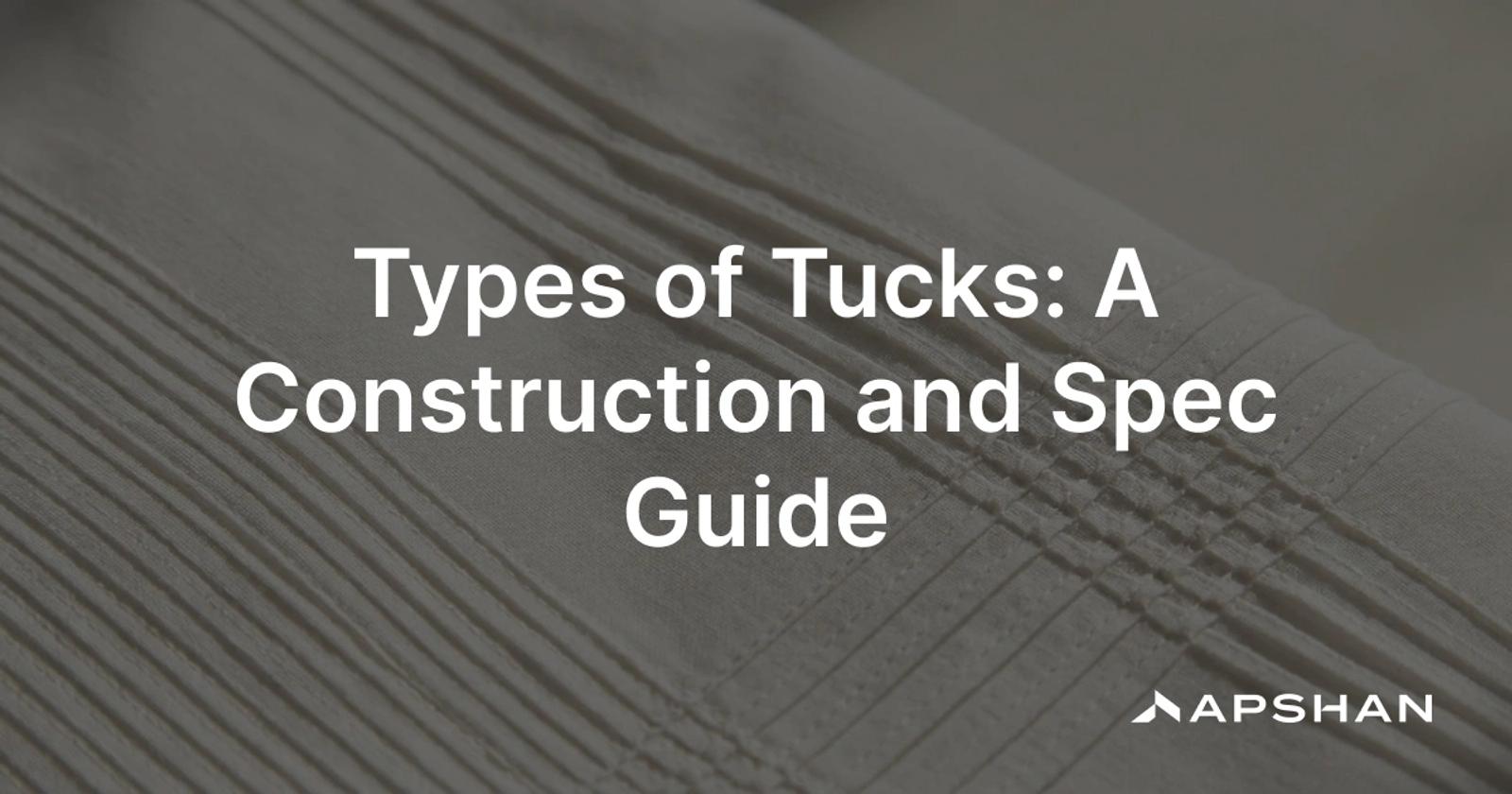
What is a tuck?
A tuck is a fold of fabric stitched down along its length. It is used two ways: to add a raised, textured pattern to the surface, or to control fullness in a neat, deliberate manner. It is mainly a design and construction detail, not a primary shaping tool like a dart.
Tucks are usually sewn on the outside of a garment, in parallel rows, and can be as fine as a pin or wide enough to read as folds. Small multiple tucks decorate shirt fronts, blouse yokes, cuffs, and heirloom and children's wear.
They are one of the oldest surface details in dressmaking, carrying a hand-made, considered look that a plain seam cannot. On a modern tech pack they read as a mark of quality, and as a cost, since they take both extra fabric and extra machine time.
Because a tuck folds fabric back on itself, it eats material and stiffens the area a little, both of which have to be planned rather than discovered on the cutting table.
Tuck vs dart vs pleat
Three details fold fabric, and they are constantly confused on spec sheets and in patterns. The difference is not the fold but what the fold is for.
- A tuck: a fold stitched down along its length, for texture or controlled fullness. It runs parallel, stays the same width, and does not shape the body.
- A dart: a wedge stitched to a point that removes fabric so the cloth curves over the bust, waist, or hip. A dart shapes the body; a tuck does not.
- A pleat: a fold of fullness usually held only at one edge and left free along its length, so it opens for movement. A pleat releases fullness; a tuck is stitched down.
The overlap is the released or dart tuck, a tuck stitched only part of the way, so it behaves a little like both. It sits between the two.
The main tuck types
Tucks are classified by how wide they are and how they are arranged. A handful cover most garments.
- Pin tuck: the narrowest tuck, only about 1 to 3 mm wide, stitched close to the fold in tight parallel rows. The decorative default on shirt fronts, blouse yokes, and heirloom wear, and the tuck most people picture.
- Spaced tuck: parallel tucks with a deliberate, even gap between each, so the spacing itself is part of the design. Usually wider than a pin tuck, and often pressed flat for a striped look.
- Blind tuck: wider tucks arranged so each fold meets the next stitch line, leaving no gap, so the tucks hide into one another for a solid, ribbed surface with no space showing.
- Cross tuck: two sets of parallel tucks stitched at right angles to each other, forming a grid of raised squares. A rich, structured texture for yokes and panels, and the order you stitch the rows changes the result.
- Shell tuck: a tuck cross-stitched at intervals so the fold scallops into a shell edge. A soft, feminine finish on lingerie, nightwear, blouses, and lightweight fabrics.
- Corded tuck: a fine cord run inside the fold before stitching, so the tuck stands raised and rounded rather than lying flat.
- Group or cluster tuck: tucks arranged in sets with wider spaces between the groups, so the surface reads as bands of texture rather than one even field. A common way to break up a plain front.
- Graduated tuck: tucks that change width or spacing across the panel, from fine to wide, for a shaded, almost ombre effect in texture that draws the eye along the garment.
- Released or dart tuck: a tuck stitched only part of the way, then left open, so fullness falls free below the stitching. It is really a partially stitched dart, used at a yoke, waist, or cuff, and it is the one tuck that also affects fit rather than just the surface.
How a tuck is made, and the fabric it eats
A tuck is simple to sew and easy to get wrong on the cutting table. You mark the fold lines, press each fold, then stitch parallel to the fold at the depth you want the finished tuck to be. Accurate marking is the whole job, because uneven tucks show instantly.
The number that matters is the take-up. A tuck uses twice its finished width in flat fabric: a 5 mm tuck eats 10 mm of cloth. Across a panel of pin tucks that adds up fast, so the extra fabric is added to the pattern before the piece is cut, never after.
- Pin tucks use a special foot: a grooved pintuck foot with a twin needle raises evenly spaced fine tucks in one pass, and a cord fed underneath makes a corded pintuck that stands more.
- Spacing sets the look: to cover an area solidly, keep the gap no wider than the tuck; leave more space for a striped, open effect.
- Press with intent: tucks are pressed to one side, alternated, or left standing, and the direction is a design choice a spec has to state, since it changes how the light catches the surface.
Because a tucked panel is really a made fabric, it is usually tucked first and then cut, the same build-it-then-use-it discipline that a seam or any other construction detail needs.
Which fabrics take tucks well
Not every fabric tucks cleanly. The fold has to press and hold, and the extra layers must not add too much bulk, so the fabric decides whether a tuck looks crisp or clumsy.
- Best: crisp lightweights: cotton lawn, poplin, fine shirting, and silk hold a sharp pin tuck and press flat, keeping the rows straight, which is why heirloom pieces and fine blouses favour them.
- Difficult: bulky or loose: heavy or thick cloth makes a bulky, stiff tuck that will not press flat, and a loosely woven fabric will not hold the fold or a crisp stitch line, so the rows wander.
- Rarely: knits: a knit stretches against the fold, so tucks are uncommon on jersey and, when used, tend to be a deliberate design effect on a stable knit rather than a default detail.
Remember that tucks stiffen the area they sit in. A field of pin tucks turns a soft fabric firm, which is a look to use on purpose, not a surprise at fitting.
Decorative tucks vs functional tucks
Tucks split by job. Most are decorative, a few are functional, and the split decides where they go on a garment.
- Decorative tucks: pin, cross, shell, and corded tucks add surface texture and a sense of craft. They signal hand-finish and lift a plain fabric, which is why they turn up on premium shirting, blouses, and occasion wear rather than on basics.
- Functional tucks: released and dart tucks control fullness, easing a fitted area into a fuller one without a hard seam or a gathered edge. On children's wear, released growth tucks are stitched into a hem or bodice so the garment can be let out and worn longer as the child grows.
A single garment can use both at once: decorative pin tucks on a yoke above functional released tucks that ease the body below, one detail carrying two jobs.
How to spec tucks in a tech pack
On a tech pack, tucks are a set of numbers, because a factory cannot reproduce a texture from a photo. The spec pins down the fold and the fabric it needs.
- Type and width: pin, spaced, blind, cross, shell, or released, and the finished width of each tuck, which together set the whole effect.
- Spacing and count: the gap between tucks and how many run across the panel, since these set the finished look and the fabric total.
- Stitch and direction: the stitch line, whether the tuck is stitched full or released partway, and which way it is pressed on the finished garment.
- Fabric allowance: the extra fabric each tuck needs, twice its width, added to the pattern so the tech pack and the cutting room both account for it.
How to use tucks well
Work from the effect. Decide whether the tuck is there to decorate or to shape, then size and space it, and plan the fabric.
- For fine texture: closely spaced pin tucks on a crisp lightweight, corded if you want them to stand up from the surface.
- For a bold grid: cross tucks on a stable, light-to-medium fabric that holds a press and keeps the squares square.
- For soft fullness: released or dart tucks at a yoke, waist, or cuff, where you want ease without a gathered look.
- Always: add twice each tuck's width in fabric before cutting, and test the tucked panel on the actual production cloth so the hand and the take-up are both known in advance.
Getting a tucked detail specced and costed right is where fashion-native knowledge helps. Apshan's Nari knowledge graph answers questions like tuck construction and spec conventions, cited to source, inside the AI assistant your team already uses. Request access.