
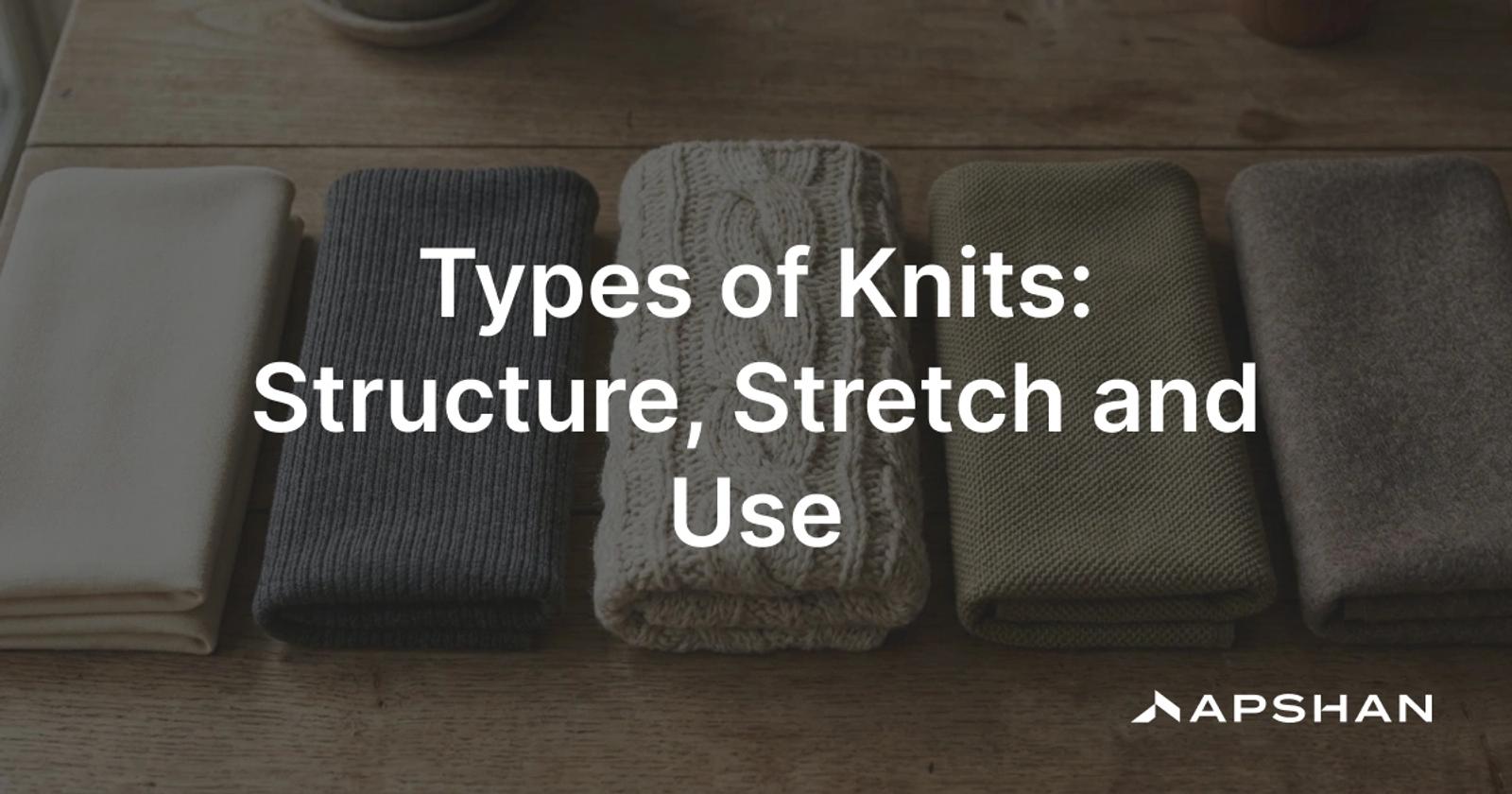
How are knits made and classified?
A knit is built by interlooping a yarn into rows of loops, unlike a woven, which interlaces two yarn sets at right angles. That loop structure is why knits stretch and resist fraying. Knits split into two families by how the loops are formed: weft knits and warp knits.
Within each family, the specific structure, single jersey, rib, interlock, tricot, and their derivatives, sets the stretch, recovery, weight, and behaviour that decide where the fabric is used.
Knitting is a younger craft than weaving, but it now dominates casualwear, activewear, and underwear. The same loop that gives stretch also makes the fabric comfortable against the body and fast to produce, which is why so much of a modern wardrobe is knitted rather than woven.
Weft knits vs warp knits
Weft knits loop one or a few yarns horizontally across each row, called a course, like hand knitting. Warp knits run many yarns vertically down the fabric, each fed by its own needle. Weft knits stretch more; warp knits are flatter, more stable, and run-resistant.
- Weft knits: made from a single yarn, or a few, looping across each course. They stretch freely, take almost any fibre, and are produced on circular or flat machines. Single jersey, rib, interlock, and pique are all weft knits, and they cover the bulk of apparel.
- Warp knits: made from many yarns running lengthwise, each guided by a needle in a zigzag path. The result is flatter, closer, less elastic, and run-resistant, usually in synthetic yarns. Tricot and raschel are the main types, used for lingerie, swimwear, and technical fabrics.
The split matters for sourcing. A weft-knit jersey and a warp-knit tricot behave differently on the cutting table and in wear, even at the same weight.
The main knit structures
Most apparel uses a handful of weft-knit structures, plus warp-knit tricot for stretch and technical pieces. Each has a signature behaviour.
- Single jersey: the basic knit, with a smooth V-face and a looped back. Light, stretchy across the width, and the workhorse of T-shirts. It curls at the cut edge, which the construction has to manage, and it uses the least yarn, so it is the cheapest to make.
- Rib (1x1, 2x2): alternating columns of face and back loops, so it looks the same on both sides and stretches strongly across the width with good recovery. That elastic pull-in makes it the default for cuffs, collars, and waistbands that need to grip and spring back.
- Interlock (double jersey): two jerseys knitted back to back, so both faces are smooth, it lies flat without curling, and it is more stable and firmer than single jersey. Heavier and more expensive per metre, it suits premium tees, polos, and dresses.
- Purl: face and back loops alternate along the column, so it looks the same on both sides and stretches lengthwise rather than across. Common in chunky knitwear and babywear, where it lies flat both ways.
- Pique: a textured weft knit with a fine waffle surface, breathable and stable with little curl. The classic polo-shirt fabric, usually cotton or a poly-cotton blend.
- French terry and fleece: loops (terry) or a brushed nap (fleece) on the back for warmth, used for sweatshirts, hoodies, and joggers. Fleece is prone to pilling and abrasion if the yarn is poor.
- Ponte de Roma: a firm, stable double knit that behaves almost like a woven. Used for structured trousers, blazers, and dresses.
- Tricot (warp knit): flat, run-resistant, and lightweight, with a smooth face and a fine rib on the back. The base for lingerie, swimwear linings, and activewear.
- Cable and jacquard: patterned knits, where crossing columns (cable) or several coloured yarns (jacquard) build texture and pattern. These are a design and gauge choice layered on a base structure, not a structure of their own.
Cut-and-sew knits vs fully-fashioned knitwear
Knits reach a garment two ways, and the route changes the spec. Cut-and-sew takes knitted yardage and cuts and sews it like any fabric. Fully-fashioned knitting shapes each panel on the machine, then links the panels, with almost no waste.
- Cut-and-sew: jersey, interlock, and french terry are knitted as rolls, then cut and sewn. This covers most jersey apparel: tees, sweatshirts, and leggings. The spec looks like a woven's, plus a stretch figure.
- Fully-fashioned (knitwear): sweaters and fine-gauge pieces are knitted panel by panel to the exact shape, then linked at the seams. The spec is driven by gauge and stitch count, not a cutting marker, and the yarn waste is minimal.
The route decides which numbers matter. Cut-and-sew leans on weight and stretch; fully-fashioned knitwear leans on gauge and stitch count.
How structure sets performance
The structure decides the properties a product developer cares about: stretch, recovery, edge behaviour, weight, and stability. These are what the tech pack has to pin down.
- Stretch and recovery: single jersey stretches mostly across the width; rib and interlock recover better; adding elastane gives controlled four-way stretch. Recovery, not just stretch, is what keeps a garment in shape.
- Edge behaviour (curl): single jersey curls at the cut edge because its face and back differ, while balanced structures like rib, interlock, and purl lie flat. Curl drives the hemming and coverstitch decisions.
- Weight (GSM): knit weight is quoted in grams per square metre, from about 130 GSM for a light tee to 400 GSM and up for fleece. Weight sets the hand and the season.
- Gauge (gg): for knitwear, gauge is the number of needles per inch on the machine: 3gg is thick and bulky, 7gg is mid-weight, and 12 to 18gg is fine and dense. Higher gauge means a finer, less pill-prone knit.
- Run and fray: knits do not fray like wovens, but a cut or dropped stitch can run, or ladder, along a column. Warp knits resist this; single jersey does not.
- Dimensional stability: knits relax and shrink more than wovens, often around 3 to 5 percent, so they are measured and tested after relaxation and the pattern carries an allowance for it.
Knits vs wovens
The core difference is loops versus grids. A knit interloops one yarn into rows; a woven interlaces warp and weft at right angles. That single fact explains most of how they behave.
- Stretch: knits stretch from the loop structure alone, even without elastane; wovens have little give unless cut on the bias or blended with a stretch fibre.
- Fray and cut: wovens fray at a raw edge and need finishing; knits do not fray, but they can curl or run.
- Construction: knits are sewn with ballpoint needles and stretch stitches, such as overlock and coverstitch, so the seam moves with the fabric. A plain straight lockstitch on a knit will pop.
- Grain and stretch direction: a knit's stretch comes from its loops, so panels are cut to the direction of greatest stretch, usually across the body, rather than relying on a woven's bias. Cutting the wrong way loses the stretch the garment relies on.
For the woven side of the story, structure by structure, see types of weave.
How to spec and sew a knit
On a tech pack, a knit is defined by more than a name. The spec pins down the structure, the fibre and blend, the weight, and the stretch, so the mill delivers the right hand and the line sews it correctly.
- Structure and gauge: single jersey, rib, interlock, or tricot, plus the gauge for knitwear.
- Fibre, blend, and finish: cotton, wool, polyester, or a blend, plus any elastane percentage and a finish such as mercerised, brushed, or anti-pill.
- Weight and stretch: the GSM and the stretch percentage in each direction, tested rather than guessed, since two jerseys at the same weight can stretch very differently.
- Construction: a ballpoint or stretch needle, and stretch seams (overlock, coverstitch), specced like any other seam.
This is the same bill-of-materials discipline the rest of a tech pack runs on, all the way through textile manufacturing: every fabric is a line with a structure, a weight, and a tolerance.
How to choose the right knit
Work from the garment. The end use sets the structure and weight, the fibre sets the hand and care, and the stretch requirement decides whether you need elastane or a warp knit.
- Tees and casual tops: single jersey or interlock, roughly 130 to 220 GSM.
- Cuffs, collars, and fitted pieces: rib, for stretch and recovery.
- Structured trousers and blazers: ponte or another stable double knit that holds a shape.
- Swim and activewear: warp-knit tricot with elastane for four-way stretch and run resistance.
- Sweaters and knitwear: choose gauge first, then fibre, from bulky 3gg outerwear to fine 12gg and above for layering pieces.
- Warmth without bulk: french terry or fleece, with an anti-pill finish and abrasion testing to protect the surface over wear.
Matching structure to end use quickly is where fashion-native knowledge helps. Apshan's Nari knowledge graph answers questions like knit structure, stretch, and spec conventions, cited to source, inside the AI assistant your team already uses. Request access.