
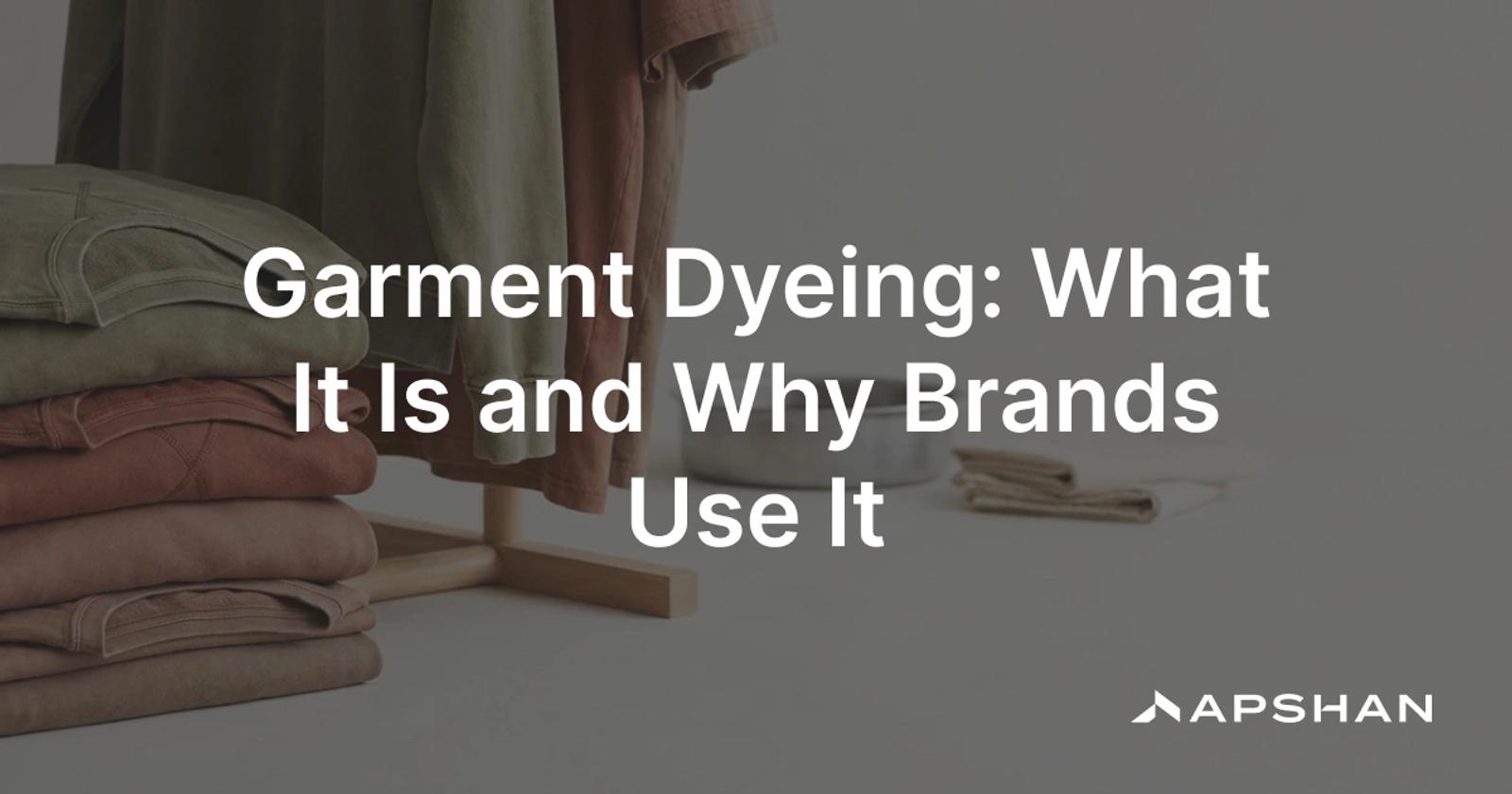
That soft, slightly uneven, lived-in colour on a good sweatshirt is not an accident, and it is not the fabric. It is the order the colour was added. Garment dyeing puts the dye in at the very last moment, after the garment is fully made, and that single change shapes the look, the feel and how a brand can buy it.
This guide covers what garment dyeing is, where it sits among the dyeing methods, why brands choose it, and its real trade-offs, as a finishing decision downstream of fabric production.
What is garment dyeing?
Garment dyeing is colouring a finished, fully constructed garment. The piece is cut and sewn from undyed fabric first, then the whole garment, seams, thread and all, goes into the dye. The colour is the last step, not the first.
That is the opposite of the usual approach, where the fabric arrives already coloured. Because the dye soaks into a made-up garment rather than a flat roll, it settles a little unevenly, deeper at the seams and collar, softer through the body, which is exactly the worn-in character brands are after.
The mechanics are straightforward. Prepared garments are loaded into a rotary or paddle dye machine, scoured to strip any residue, dyed in a heated bath, then rinsed, softened and dried. The whole garment, body, sleeves, pockets and stitching, moves through the colour together, which is why the result reads as one integrated piece rather than parts assembled from pre-coloured fabric.
Where garment dyeing sits: the four dye stages
Colour can be added at four points in making a textile, and garment dyeing is the last. The earlier the dye goes in, the more uniform and colour-fast the result; the later it goes in, the more character and flexibility, and the less consistency.
- Fibre (stock) dyeing: the loose fibre is dyed before it is even spun into yarn, the earliest and most colour-fast point.
- Yarn dyeing: the yarn is dyed before weaving or knitting, which is how patterns like stripes, checks and plaids are made.
Piece (fabric) dyeing: the woven or knitted fabric is dyed in rolls before cutting, giving an even, uniform colour. This and yarn dyeing are the fabric-stage methods that sit inside fabric production.
- Garment dyeing: the finished, sewn garment is dyed as a whole, the latest point, giving tonal variation and late colour choice.
Why brands use garment dyeing
If earlier dyeing is more consistent, why dye last? Because garment dyeing buys two things nothing else does: a distinctive look and a much later colour decision.
- The lived-in look and soft hand: the gentle tonal variation and the softer, broken-in feel come built in, especially on knits, and darker shades read deeper and richer.
- Colour on demand: because the garment is dyed last, a brand can hold undyed blanks and dye to actual demand, in small batches, choosing colours late instead of committing months ahead.
- Lower colour risk and MOQs: one undyed body can become many colours, so a brand carries less colour-forecasting risk and can order smaller runs per shade.
- Pre-shrunk by the process: the garment has already been through a hot wet process by the time it ships, so it tends to shrink less for the customer afterwards.
The limits of garment dyeing
The same thing that gives garment dyeing its character, dyeing a made-up garment, is what makes it harder to control. The trade-offs are real and worth planning for.
- Colour consistency: matching shade exactly from batch to batch, and even within a batch, is harder than with fabric dyeing, so tight colour standards are difficult.
- Shrinkage and distortion: finished garments can shrink or distort in the dye bath, which is why they must be cut oversize to land at the right size after dyeing.
- Component compatibility: the sewing thread, labels and trims all have to survive and take the dye correctly, or the garment comes out with mismatched stitching.
- Fabric limits: not every fabric or fibre garment-dyes well, which narrows the material options.
There is a sustainability wrinkle as well. Dyeing to demand can cut overproduction and dead stock, a genuine gain, but dyeing garments a batch at a time is less water and energy efficient per piece than dyeing fabric in bulk. Whether it nets out greener depends on how much waste the flexibility actually saves.
Prepared for garment dyeing (PFGD)
Garment dyeing only works if the garment was built for it. A garment made from ordinary dyed or optically-whitened fabric cannot simply be thrown in the dye. It has to be prepared for garment dyeing, or PFGD.
- Undyed, un-whitened fabric: made from off-white greige fabric with no optical brighteners, which would otherwise block the dye.
- Dyeable thread: sewn with cotton or otherwise dyeable thread so the stitching takes the same colour as the body, rather than staying white.
- Cut oversize: patterned larger than the target size, because the garment will shrink in the dyeing and wet process.
Getting PFGD right is a specification job as much as a dye-house one, and it belongs in the tech pack from the start, alongside the target shade and its tolerance.
Reactive vs pigment garment dye
Within garment dyeing, the dye type decides the finish, and two dominate.
- Reactive dye: bonds chemically with the fibre, so the colour is vibrant and highly wash-fast. It is the choice for rich, lasting colour on cotton and other cellulosics.
- Pigment dye: sits on the surface, held by a binder rather than bonding into the fibre. It gives the soft, faded, vintage look and fades further with wear, which for many garment-dyed pieces is the whole point.
So the same garment-dyeing process can produce either a deep, durable colour or a washed, worn one, depending on which dye is used, which is part of why the term covers such a range of looks. It is also why garment dyeing shows up most on casual, knit-heavy product, tees, sweats and casual trousers, where a soft hand and tonal character are wanted, and far less on tailoring, where sharp, uniform colour is the point.
Garment dyeing vs garment washing
These two finishing steps are easy to confuse because both happen to the finished garment and both give a lived-in feel, but they do different things.
- Garment dyeing: adds or sets the colour of the whole garment, deciding what shade it is.
- Garment washing: takes an already-coloured garment and fades, softens or distresses it, changing how that existing colour looks rather than what it is.
They are often used together: a garment can be dyed for its base colour and then washed for extra fade and softness, which is how a lot of the worn-in casualwear look is built.
From a colour decision to a demand decision
Garment dyeing's real advantage, choosing colour late and in small batches, only pays off if you know which colours demand will actually want. That makes it a demand decision as much as a dyeing one. Apshan builds the connected, sourced read on demand and production that informs it. See how it feeds textile sourcing, request access, or view the plans and pricing.