
What is fabric calendering?
Fabric calendering is a mechanical finishing process that presses cloth between heated rollers under pressure to change its surface. It can smooth the fabric, close the weave, raise a lustre, or press in a pattern, depending on the rollers and the settings.
- It is mechanical, not chemical: calendering changes the fabric by heat and pressure, not by adding a substance. It is the textile equivalent of a very heavy, precise ironing.
- It is a finishing step: it happens near the end of production, usually after dyeing, when the fabric is otherwise made and the job is to set its final surface and hand.
So calendering is not a weave or a fibre; it is something done to a finished cloth. The same greige fabric can leave the calender smooth and matte or high-gloss and patterned, which is why the finish, not just the cloth, has to be specified.
How a calender works
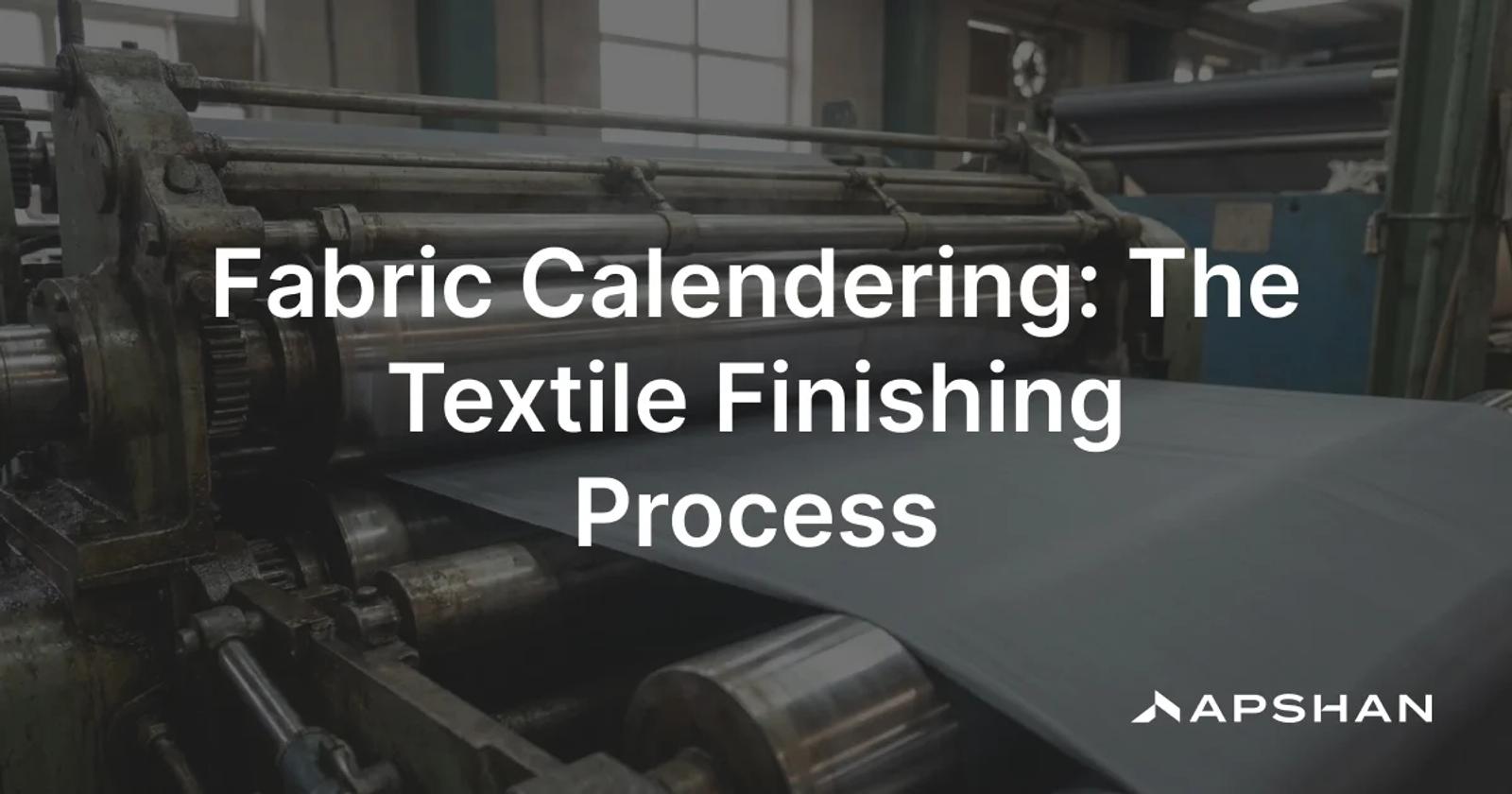
A calender is a stack of heavy rollers, called bowls, that the fabric passes between. The effect comes from the combination of heat, pressure, moisture and speed at the nip where the bowls meet.
- Hard and soft bowls: the stack alternates hard bowls, of polished or chilled steel and often heated, with soft bowls of compressed cotton or paper. A machine may hold three to ten bowls.
- The variables that set the effect: bowl temperature, the pressure at the nip, the fabric's moisture content, and the relative speed of the bowls. Change these and the same fabric takes a different finish.
- The nip does the work: as the cloth is squeezed through the gap between two bowls, the yarns are flattened and the surface is pressed against the bowl, which is what smooths it or transfers a pattern or polish.
Moisture and temperature do much of the work. A little dampness in the fabric lets the yarns flatten and set under the heated bowl, much as steam helps an iron; too little and the effect is weak, too much and it smears. The settings are matched to the fibre, which is why a calendering recipe is specific to a cloth.
The important idea is that calendering is a family of processes, not one. What separates a plain smoothing pass from a mirror glaze or an embossed pattern is how the bowls are engraved, heated and driven, which the types below set out.
The main types of calendering
Calendering is named by the effect it produces, and the effect is set by the bowls. These are the types a buyer will meet.
- Simple or swissing: all bowls run at the same speed to smooth the fabric and close the weave, giving a clean surface and a soft sheen without a high glaze. The everyday calendering finish.
- Friction, or glazing: one bowl is driven faster than the fabric, buffing the surface to a high gloss. The fabric is often treated with starch, wax or resin first. It produces glazed cottons and chintz.
- Embossing: an engraved, heated roller presses a raised pattern or texture into the cloth against a softer roll. It works best on soft or thermoplastic fabric, and the pattern is often temporary.
- Moire: a watered, wavy effect, created either by an engraved roller or by pressing two layers of ribbed fabric together in a single high-pressure pass.
- Schreiner: a steel bowl engraved with a few hundred fine diagonal lines per inch presses a soft, silky, low-key lustre into the surface, distinct from the high shine of glazing. Common on cotton and sateen.
The dividing line between a plain finish and a glaze is bowl speed. When every bowl turns at the same speed, the fabric is simply smoothed and pressed. When one bowl is driven faster than the cloth, it rubs, or frictions, the surface to a shine, which is why the high-gloss version is called friction calendering. The engraving on a bowl, meanwhile, is what turns pressure into a pattern or a directional lustre.
Common calendered fabrics and effects
Several familiar fabric finishes are really calendering under another name. Recognising them makes the process concrete.
- Chintz and polished cotton: the high-gloss glazed finish from friction calendering, often set with resin so it survives use.
- Moire taffeta and silk: the rippled, watermark-like sheen produced by moire calendering.
- Schreinered sateen and lingerie fabric: the soft, deep lustre from Schreiner calendering, used where a subtle sheen is wanted rather than a shine.
In each case the base cloth could be plain. The look that names the fabric is the calendering, which is why a buyer specifying chintz or moire is really specifying a finish and its durability, not only a weave or fibre.
What calendering achieves
Calendering is used for a mix of practical and decorative reasons, sometimes both at once on the same fabric.
- A smoother, flatter surface: it removes crimp and waviness left after weaving and dyeing, giving a cleaner, more even face.
- Lustre and hand: from a soft sheen to a mirror glaze, calendering changes how a fabric catches the light and how it feels.
- A closer, denser weave: pressing the yarns flat closes the gaps between them, which can make a fabric more wind-resistant or opaque.
- Decorative effects: embossed patterns, moire ripple and glaze are all surface effects a plain cloth cannot get from weaving alone.
There are trade-offs. Pressing the yarns flat changes the hand, and an over-calendered fabric can feel hard, papery or lifeless, losing the loft and drape a garment may need. A high glaze also shows wear and creasing more than a matte surface. The finish is a choice, not a free upgrade, and it should suit the product rather than be applied for shine alone.
Is a calendered finish permanent?
This is the question that decides whether a calendered fabric is fit for its use, and the honest answer is: usually not, on its own. Ordinary calendering is a temporary finish.
- Temporary by default: on a normal, untreated natural fibre, the flattened yarns spring back once the fabric is wetted or washed, and the smoothness or gloss fades. The effect is mechanical, and water undoes it.
- Durable with resin: treating the fabric with a resin binder before calendering, then curing it, holds the effect through washing. This is how a glazed chintz keeps its shine.
- Permanent on thermoplastic fibres: on fibres that soften with heat, such as polyester or nylon, the calender can set the effect permanently, because the fibre itself is reshaped rather than just pressed.
This matters commercially, not just technically. A glazed or embossed finish that washes out after the first laundry turns into returns and complaints if the customer expected it to last. Matching the durability of the finish to how the garment will be cared for, and saying so on the label, is part of getting calendering right.
So durability is not a property of calendering itself; it depends on the fibre and any chemical treatment. A buyer who wants a glaze or emboss to last has to specify how it is made permanent, not just that the fabric is calendered.
Calendering versus mercerising and sanforising
Calendering is one of several mechanical or chemical finishes, and it is easy to confuse with others that also change a fabric's surface or behaviour. They do different jobs.
Versus dyeing and colour finishes: calendering is a physical surface finish applied after dyeing, not a colour process. It changes lustre and hand, not shade.
- Versus sanforising: sanforising is a mechanical finish too, but its job is to pre-shrink the fabric so it will not shrink later, not to add lustre or a surface effect.
- Versus mercerising: mercerising is a chemical treatment of cotton with caustic soda that adds lasting lustre and strength. Calendering can add a similar sheen mechanically, but without the permanence or the strength gain.
The clean way to hold them apart is by what they change and how long it lasts. Calendering presses the surface, and the effect is temporary unless fixed; mercerising and sanforising change the fibre or the fabric's dimensions more durably.
How to spec calendering in sourcing
On a fabric standard, calendering is worth naming precisely, because the same word covers a plain smoothing pass and a permanent glaze, which are not the same product.
- Name the effect, not just the process: state whether you want a simple smooth finish, a friction glaze, an emboss, a moire or a Schreiner lustre, since each needs different bowls and settings.
- Specify the durability: say whether the effect must survive washing, and if so require the resin treatment or thermoplastic fibre that makes it last, rather than assuming a calendered finish is permanent.
- Test it like any finish: check the finish against washing and use the way you would any other finish, so a glaze or emboss that is meant to last is proven to, not taken on trust.
Knowing which calendering effect, fibre and treatment fit a given fabric and end use is the fashion-native detail Apshan's Nari knowledge graph answers, cited to source, inside the AI assistant your team already uses. Request access.