
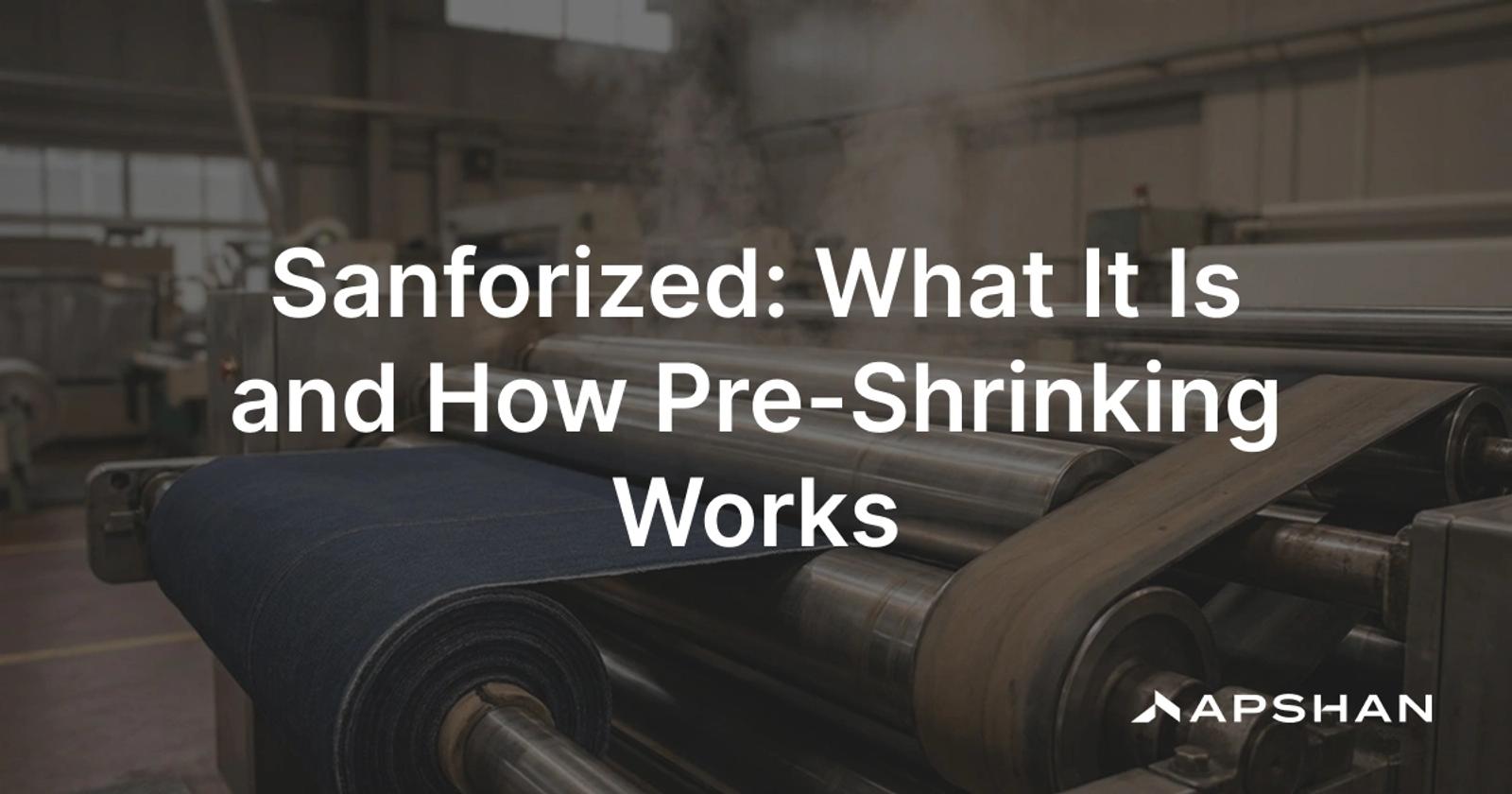
A garment that fits in the shop and shrinks two sizes in the first wash is a returns problem waiting to happen. Sanforization is the process that stops it: it takes the shrinkage out of the fabric at the mill, before a single garment is cut.
If you have shopped for raw denim you have seen the word, but sanforization is a production decision long before it is a denim-nerd one. This guide covers what it is, how it works, how much fabric still shrinks, and why it belongs in your tech pack.
What is sanforization?
Sanforization is a controlled compressive shrinkage process: woven fabric is forced to shrink in length by compression, so it will not shrink much more once it becomes a garment. It is purely mechanical, using heat, moisture and pressure, with no chemicals added.
The technically correct name is controlled compressive shrinkage, but almost everyone calls it sanforizing. The word comes from Sanford Lockwood Cluett, the American inventor who patented the process in 1930; Sanforized is still a registered trademark of the Cluett Peabody company. Before it existed, essentially every pair of jeans in the world was shrink-to-fit.
The process spread fast once it worked. Sanforized denim first appeared in the mid-1930s, and within a generation compressive shrinkage was standard across the textile industry. Levi's kept its 501 shrink-to-fit into the 1960s, long after the rest of the market moved to pre-shrunk cloth, which is part of why raw denim still carries a heritage appeal today.
How does sanforization work?
A sanforizing machine does in minutes what a hot wash would otherwise do to a finished garment. The fabric runs through a short, continuous sequence.
- Moistening: the fabric is dampened with steam or water, which lubricates the fibres and readies them to move.
- Compression: it is pressed against a thick rubber belt that has been stretched, then allowed to relax. As the belt contracts to its normal length, it drags the fabric with it, crimping the warp yarns and compacting the weave.
- Drying and setting: the fabric passes through a dryer, which removes the moisture and locks the new, pre-shrunk dimensions in place.
The result is a fabric whose weave has already done most of its shrinking, so the finished garment holds its measurements through washing.
Because the shrinkage comes from re-crimping the warp yarns rather than removing any material, sanforizing does not weaken the cloth or change its fibre content. It is essentially the same fabric, settled into the dimensions it would have reached after a wash, though it can read slightly flatter and denser than loomstate.
How much does sanforized fabric shrink?
Sanforized fabric is held to a residual shrinkage of about 1% or less, the standard the trademark was built on, against 5 to 10% for untreated fabric. In denim specifically, sanforized cloth often settles in the 1 to 3% range in real use, still a fraction of raw fabric's movement.
On a spec sheet, shrinkage is not one number but a small set of tolerances a mill is expected to hold.
- Residual shrinkage: commonly specified at 1% or less in both the warp and the weft direction.
- Skew and bowing: limits on how much the weave twists or curves, often around 2% skew and 1% bowing.
- Moisture regain: a target moisture content, roughly 6 to 8% for cotton, since bone-dry fabric reads a false shrinkage.
Those numbers are not taken on trust. Residual shrinkage is measured with a standard wash test, an AATCC or ISO method: the fabric is marked at a set distance, washed and dried under defined conditions, then remeasured, and the change is the residual shrinkage. That is what a shrinkage tolerance on a spec sheet actually refers to, and what a mill test certificate or a fabric inspection can confirm before you cut.
Unsanforized fabric, by contrast, carries its full shrinkage into the garment. That is a defect for a basics brand and a feature for raw denim, which is the distinction the next section untangles.
Sanforized vs unsanforized vs one-wash denim
Raw denim starts as loomstate cloth straight off the loom, and what happens next is what these labels describe.
- Loomstate: completely untreated fabric, straight off the loom, with zero processing.
- Unsanforized (shrink-to-fit): loomstate denim cut and sewn without pre-shrinking. It can shrink 5 to 10%, sometimes two or three tag sizes, on its first soak, so buyers size up on purpose.
- One-wash: unsanforized denim that has been soaked or washed once to take out the initial shrinkage and soften it, so it fits closer to its labelled size.
- Sanforized: mechanically pre-shrunk at the mill, ready to wear, and stable at about 1 to 3% shrinkage, so there is no need to size up.
Raw-denim enthusiasts often prefer unsanforized for the character and personal fit it develops, and accept the shrinkage gamble. For almost everything else, from uniforms to basics, sanforized is what makes consistent sizing possible.
Sanforized (woven) vs compacted (knit)
One point trips people up: sanforizing is a woven-fabric process. It suits denim, twill, poplin and other woven cloth, where warp and weft can be compressed against each other.
Knit fabrics, like jersey and fleece, get the same result from a different machine and process called compacting. If you are specifying a knit tee rather than a woven shirt, you ask for compacted fabric, not sanforized, but the goal, controlled shrinkage before cutting, is identical. Both are finishing steps that sit downstream of fabric production.
Why sanforization matters for production
For a brand, sanforization is not trivia; it is a cost and quality lever that shows up in three places.
- Sizing that holds: the obvious one. Pre-shrunk fabric keeps a garment on-spec after washing, which cuts fit complaints and returns, the same reliability a clear tech pack is meant to protect.
- Cleaner pattern and yield math: with shrinkage removed, patterns can be nested precisely and fabric consumption calculated accurately, with no guesswork shrinkage allowance baked into every panel.
- A spec you can hold suppliers to: naming sanforized fabric and a maximum residual-shrinkage tolerance in the fabric spec gives you a measurable line an inspection can check, rather than a vague expectation.
It is also a materials decision with a trade-off. Sanforizing can flatten a denim's texture slightly, which is exactly why some premium makers choose unsanforized despite the shrinkage, so the right call depends on the product, not a blanket rule.
What sanforization does not do
Sanforized does not mean shrink-proof, and treating it that way causes disappointment.
- It is not zero shrinkage: it removes most relaxation shrinkage, but very hot water and high-heat drying can still move any fabric, and it does nothing about fibre-level shrinkage such as wool felting.
- It is not a wash or an appearance finish: sanforizing does not soften, distress or colour the cloth; it only stabilises the dimensions.
- It is not the same as pre-washed: a pre-washed garment is laundered after it is sewn, while sanforizing treats the fabric before it is cut, so the two solve the shrinkage problem at different stages.
From a fabric spec to a sourcing decision
Whether to sanforize, and to what tolerance, is a sourcing and product decision that ripples into fit, yield and returns. Apshan builds the connected, sourced read on materials and production that informs those calls. See how it feeds textile sourcing, request access, or view the plans and pricing.