
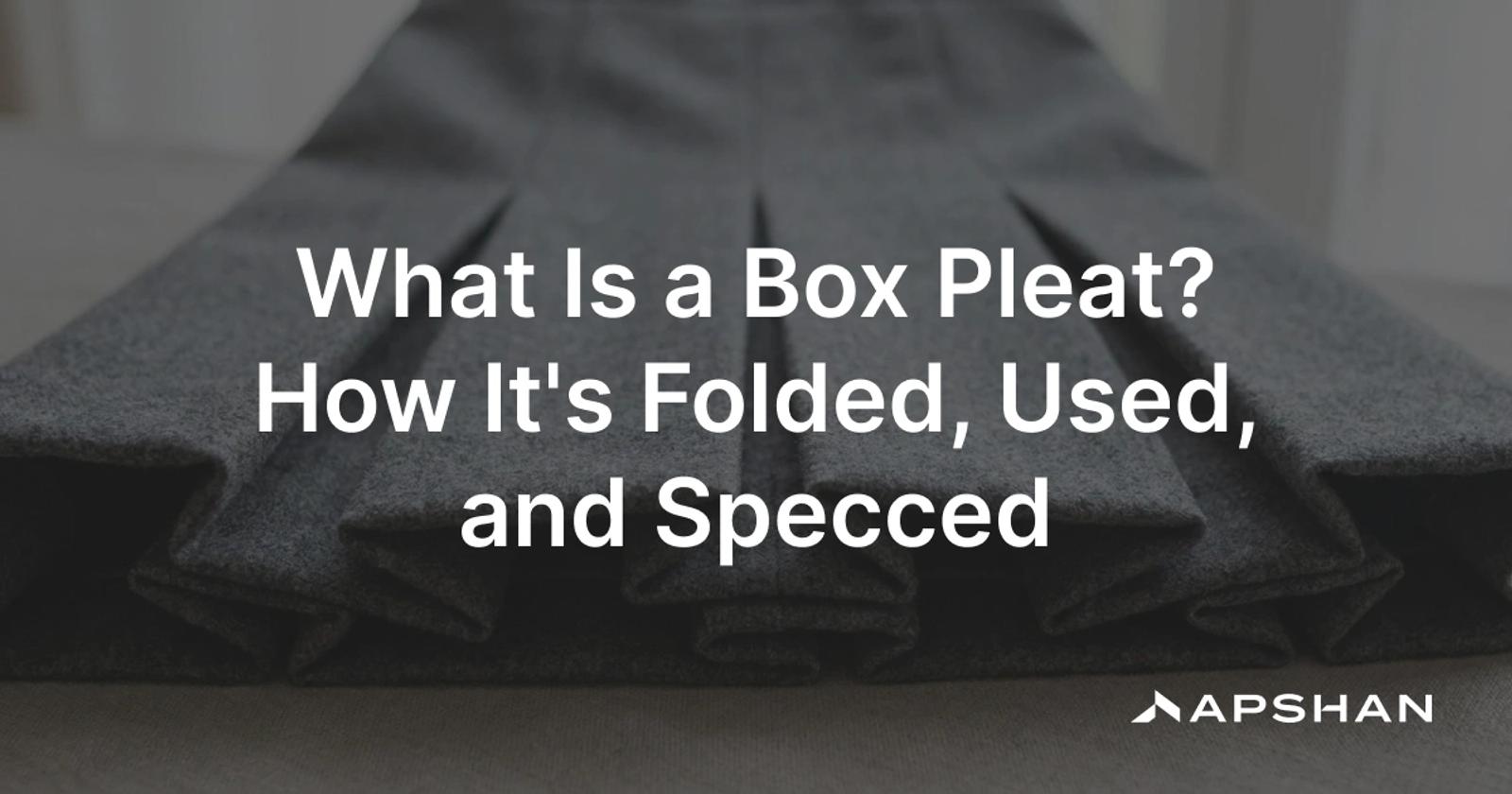
What is a box pleat?
A box pleat is a fold that stands out from the fabric like a low, flat box. It is made from two knife pleats turned away from each other, so their outer folds face out and the extra fabric, the fullness, is tucked behind. From the front you see a clean, raised panel with a crisp edge on each side.
That structure is the point. A box pleat adds controlled fullness and holds a defined shape, which is why it is the pleat of school-uniform skirts, A-line and box-pleat skirts, shirt and blouse backs, and tailored curtains. It reads as neat and architectural rather than soft and gathered.
It is one of the types of pleats, and it is easiest to understand next to its two close relatives, the knife pleat and the inverted pleat.
Box pleat vs knife pleat vs inverted pleat
These three are one family. A box pleat is literally built from knife pleats, and an inverted pleat is a box pleat seen from the other side, so once you see how they relate the names stop being confusing.
- Knife pleat: a single fold, all folds facing the same direction, like the pleats around a kilt or a classic pleated skirt. It is the simplest pleat and the building block from which the other two are made.
- Box pleat: two knife pleats folded away from each other, meeting at the back. The outer folds face outward and the pleat sits proud of the fabric, giving that boxy, symmetrical look. It is the most structured of the three and holds its shape best.
- Inverted pleat: the same construction flipped over. The two folds face toward each other and meet at the front, hiding the fullness in a seam-like line. Make a box pleat, turn the fabric over, and you have an inverted pleat, which is why the two terms are so often mixed up.
So a box pleat and an inverted pleat are the same fold viewed from opposite sides: outer folds out is a box pleat, folds meeting in front is inverted. Both are made from a pair of knife pleats.
The practical upshot is that if you can fold and sew one, you can make the other, and the fabric maths below is the same for both. It also explains a lot of loose naming: what a curtain-maker calls an inverted pleat and a skirt-maker calls a box pleat can be the identical fold, just presented face-up or face-down.
How a box pleat is folded
A box pleat is simple to form once the measurements are set, and a couple of details decide whether it looks crisp or sloppy.
- Two folds, one box: fabric is folded under on each side toward a shared centre at the back, so two outer creases sit a set distance apart on the face. The distance between the outer fold and the inner fold is the pleat depth, and the hidden fabric on each side, twice that depth, is the underlay.
- Depth under half the width: the underfold on each side must be less than half the visible pleat width, or the two underfolds overlap at the back and add needless bulk. This is the one rule that keeps a box pleat clean.
- Pressed or unpressed: press the folds and the pleat is sharp, flat, and structured, the school-uniform look; leave them unpressed and the pleat falls as soft, rounded fullness. Same construction, very different result, and it is a decision the spec has to make explicit rather than leave to chance.
- Mind the bulk: where a pleat is caught into a waistband or seam, the raw edges inside are left unfinished or trimmed, because layering four thicknesses of a finished edge makes the seam bulge.
- Baste and topstitch: the pleats are usually basted or pinned, then stitched across the top to hold the fold in place, and on many skirts topstitched down for a few centimetres so the pleats lie flat over the hip and only release lower down.
Precision is what separates a good box pleat from a homemade one. The pleats have to be evenly spaced and identical in depth, or the eye immediately reads the row as uneven, which is why factories mark and fold to templates rather than by eye.
How much fabric a box pleat takes
This is the number that catches people out, and it is the one that matters for costing a garment. A box pleat eats far more fabric than its finished width suggests.
- The formula: fabric for one box pleat equals the visible pleat width plus four times the underfold depth (two underfolds, each folding back and returning). Multiply by the number of pleats, then add any flat spaces between them.
- The rule of thumb: for a full box pleat, where the underfolds meet at the back, that works out to about three times the finished width. A 10 cm box pleat needs roughly 30 cm of flat fabric, and a whole pleated skirt can swallow three panels' worth of cloth for one finished panel.
- Stacked pleats cost more: a double box pleat (one stacked on another) uses about five times the width, and a triple about seven times, not double and triple. Stacking condenses a lot of fabric into a small span, which is how dramatic, sweeping skirts and gown trains are built.
A quick worked example makes it concrete. Say you want six touching box pleats, each 8 cm wide on the face, with a 4 cm underfold on each side. Each pleat uses 8 + (4 by 4) = 24 cm of flat fabric, so six pleats need about 144 cm of cloth to produce roughly 48 cm of finished, pleated width. Miss that and the panel comes up short at the cutting table.
This is also why pleated garments cost more than their plain equivalents: the fabric bill alone can be two to three times higher before a stitch is sewn, and deep or stacked pleats push it further. On a costed range, the pleat depth is as much a budget decision as a design one.
Where box pleats are used
Box pleats turn up wherever controlled, structured fullness is wanted rather than soft gathers. The type and placement follow the garment.
- Skirts: box-pleat and A-line skirts, and the classic school-uniform skirt, where evenly spaced box pleats give swing at the hem without bulk at the waist, especially when the top of each pleat is stitched flat over the hip and released below.
- Shirt and jacket backs: a single box or inverted pleat at the centre back of a shirt or blouse adds room to move across the shoulders, the classic detail on a dress shirt yoke and on the back of many casual shirts.
- A single inverted box pleat: set at a centre front or back seam of a skirt or dress, it adds walking room while looking, from the front, like a plain seam, which is why it is a favourite on straight and pencil skirts that would otherwise restrict the stride.
- Home textiles: tailored curtains, valances, and bed skirts often use box pleats for a crisp, formal, evenly spaced heading.
The choice of box over knife or gathered fullness is usually about how structured the garment should read. Box pleats hold their own shape and give a tailored, slightly formal line; knife pleats give directional movement; soft gathers give volume without any of that structure. A designer picks the pleat to match how sharp or how fluid the piece is meant to look.
How to spec a box pleat in a tech pack
On a tech pack, a box pleat is a set of measurements plus a press instruction, because the fold is only as good as the numbers behind it. Leave any of them to the factory's judgement and the pleats come back uneven or the fabric consumption is wrong. Pin down the geometry and the finish.
- Width, depth, and spacing: the visible pleat width, the underfold depth (kept under half the width), and the gap between pleats, since these set both the look and the fabric consumption. Touching pleats give dense, formal fullness; spaced pleats give a lighter, more casual rhythm.
- Pressed or unpressed: state whether the pleats are pressed sharp or left soft, and whether they are edge-stitched or topstitched down for part of their length to hold the shape.
- Fabric consumption: carry the take-up (about three times the finished width for full box pleats) onto the tech pack so the fabric order and cost are right from the start.
- How the pleat is set: whether the pleats are sewn and pressed or, for permanent pleats in synthetic cloth, heat-set by a commercial pleater, reproduced consistently across textile manufacturing for the whole run.
Knowing which pleat, depth, and take-up fit a given garment is the fashion-native detail Apshan's Nari knowledge graph answers, cited to source, inside the AI assistant your team already uses. Request access.