
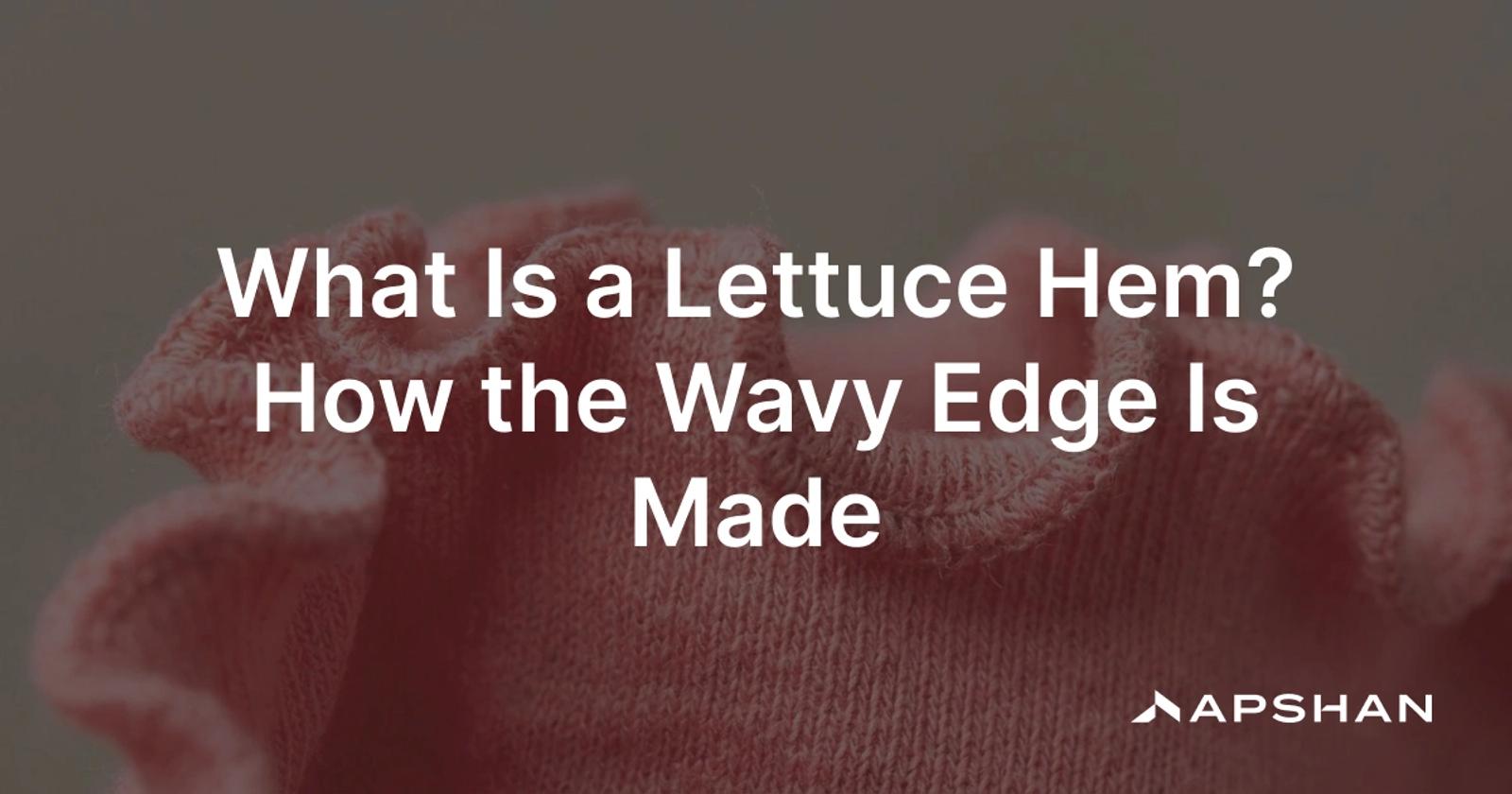
What is a lettuce hem?
A lettuce hem is a wavy, ruffled edge finish, named for the way it curls like the frilly edge of a lettuce leaf. Unlike an ordinary hem, which is meant to disappear, a lettuce hem is decorative: the ripple is the point, and the stitching is on show.
It is one of the types of hems, but a special case, because it is a knit finish that adds movement rather than a neat, invisible turn-up. You see it on activewear, dancewear, lingerie, jersey tees, children's clothes, and anywhere a soft, playful frill suits the garment.
It goes by a few names, lettuce edge, lettuce leaf hem, or just lettucing, but they all describe the same rippled finish. It is closer to a decorative edge treatment than a true hem, because there is no fold and nothing is turned under; the raw edge itself is stitched and made to wave.
The catch, and the thing most guides skate over, is why it waves at all. That comes down to a simple bit of fabric behaviour, and understanding it is what lets you control the result rather than hope for it.
How the lettuce hem gets its wave
The wave is not sewn in; it forms on its own when the fabric relaxes. The trick is to stretch the knit edge as hard as you can while you stitch over it, so the stitches lock the edge at its stretched, longer length.
When you let go, the body of the fabric springs back to its relaxed size, but the sewn edge cannot: it is now permanently longer than the fabric behind it. That extra length has nowhere to go but up and down, so the edge ruffles into waves. The bigger the stretch while sewing, the longer the locked edge, and the deeper the ripple.
- Stretch is the whole mechanism: pull the edge firmly, front and back, as it feeds under the needle or through the serger. No stretch, no wave, just a flat stitched edge, which is the giveaway when a lettuce hem comes out disappointingly straight. The more you stretch as you stitch, the more the edge is forced to ruffle once it relaxes back to its resting length.
- More stretch, more wave: the amount of ripple is dialled purely by how hard you pull, so a quick sample on the real fabric tells you the look before you commit to the garment or the whole run.
- Recovery holds it: the knit needs good recovery (the ability to spring back) so the body pulls in tight against the stretched edge; a fabric with poor recovery gives a limp, half-hearted frill.
This is also why the wave is permanent rather than something that presses out. The edge has been physically set longer than the fabric during stitching, so there is no way for it to lie flat again without unpicking it. It is the same principle as an accidental stretched-out neckline, only here it is done on purpose and controlled.
Which fabrics work, and which do not
A lettuce hem only works on fabric that stretches and springs back, which rules out most of what people try to use it on. The fabric does most of the work, so the choice matters more than the machine.
- Best on: light, stretchy knits with good recovery, single jersey, rib, and spandex blends, especially ones that already curl at a cut edge, since that curl feeds straight into the ruffle.
- Also good: thin, drapey knits like fine cotton or rayon jersey, the featherweight matte jerseys the finish was born on, which take a deep, fluid ruffle rather than a stiff one.
- Poor or no result: heavy, stable, or ponte-type knits with little stretch give only a weak wave, because there is less spring to pull the edge in and the thick fabric resists rippling.
- Will not work: wovens, silk, and any non-stretch fabric. A cut woven edge does not shorten when released, so there is nothing to make it ripple; those fabrics need a rolled or narrow hem instead. Bias-cut wovens flute a little when stretched, but that is a different, gentler effect, not a true lettuce hem.
How a lettuce hem is sewn
There are three common ways to make a lettuce hem, and they differ in speed and in how the edge is finished, not in the basic stretch-and-stitch principle. Whichever you use, the edge is stitched flat rather than folded, and the fabric is pulled taut as it feeds.
- Narrow zigzag on a sewing machine: a short, dense zigzag worked along the stretched edge, catching it and rolling it over as it goes. It is the accessible home method, and close to the one the finish was originally made with, though it can be slower and less even than a serger.
- Rolled edge on an overlocker: a serger set to a narrow rolled hem, run with the fabric stretched hard and often with the differential feed lowered, gives the cleanest, most consistent wave and is the usual choice for knitwear and the fastest by hand or in a small studio.
- Coverstitch in production: in textile manufacturing, lettuce edges are run on a coverstitch or overlock machine with the operator or a mechanical puller stretching the fabric to a set tension, so the wave is fast, even, and repeatable across a whole production run.
Whichever machine, a scrap test decides the settings: stitch width and length, differential feed on a serger, and how hard to pull, because every knit waves differently.
The direction of stretch matters too. A lettuce hem waves most along the direction the knit stretches most, usually across the width, so an edge cut across the stretchiest grain ruffles more than one cut along a stabler direction. On a curved or circular hem the effect is uneven unless the stretch is kept consistent all the way round, which is another reason a sample is worth the few minutes it takes.
Where the lettuce hem comes from, and where it is used
The lettuce hem is not just a technique, it is a piece of fashion history with a named inventor, which is unusual for a hem.
The American designer Stephen Burrows created it in the early 1970s, working with featherweight matte jersey and finishing his hems with a stretched zigzag, often in vivid red thread. Accounts of the origin differ, from a happy accident overstretching the jersey to a request from the Vogue editor Diana Vreeland for a dress in lettuce green, which he reinterpreted as the rippled leaf-like edge, but either way the fluted edge became his signature and a symbol of disco-era knitwear.
It has come back in waves since: on 1990s babydoll tees, and again recently on Y2K-revival and upcycled pieces, where a lettuce edge is a quick way to make a plain knit look intentional. For a brand, that cyclical, nostalgic quality is part of the point: the finish instantly signals either seventies disco or nineties-revival, depending on how it is styled.
- Activewear and dancewear: leotards, leggings, skirts, and gymwear, where the stretch is already there in the fabric and the frill reads as sporty, retro, or playful.
- Jersey tops and kidswear: tee necklines, sleeves, and hems, and children's clothes, where a soft, forgiving edge suits the fabric and there is no stiff hem to irritate.
- Lingerie and ruffles: light, stretchy pieces and added frills, close to the fine matte jersey the finish began on, where a soft fluted edge stays comfortable against the skin.
- Upcycling and refashions: a fast way to update a plain knit tee or dress, which is why it surged again with the recent interest in reworking thrifted clothes.
How to spec a lettuce hem
On a tech pack, a lettuce hem is short to specify but easy to get wrong, because it depends more on the fabric and the stretch than on a measurement. Name the finish and the variables that control it.
- Call it a decorative edge: state lettuce hem, and note that it is a raw-edge finish with no turn-up or hem allowance, unlike a folded hem, so the pattern is cut to the finished length and the marker does not add a hem deep-fold.
- Fabric and stretch: specify a knit with good stretch and recovery, since the fabric, not the stitch, creates the wave, and confirm it on a sample before bulk. A substitution to a stabler knit will quietly kill the effect.
- Stitch and thread: the stitch (narrow zigzag or rolled overlock), the thread type, and, if the edge is a design feature, a contrasting thread colour in the Burrows spirit rather than a matched one that hides the stitching.
- Amount of wave: how pronounced the ripple should be, since it is set by how hard the edge is stretched; pair it with the right types of hems elsewhere on the garment so the finishes are deliberate.
Knowing which hem, stitch, and fabric fit a given garment is the fashion-native detail Apshan's Nari knowledge graph answers, cited to source, inside the AI assistant your team already uses. Request access.