
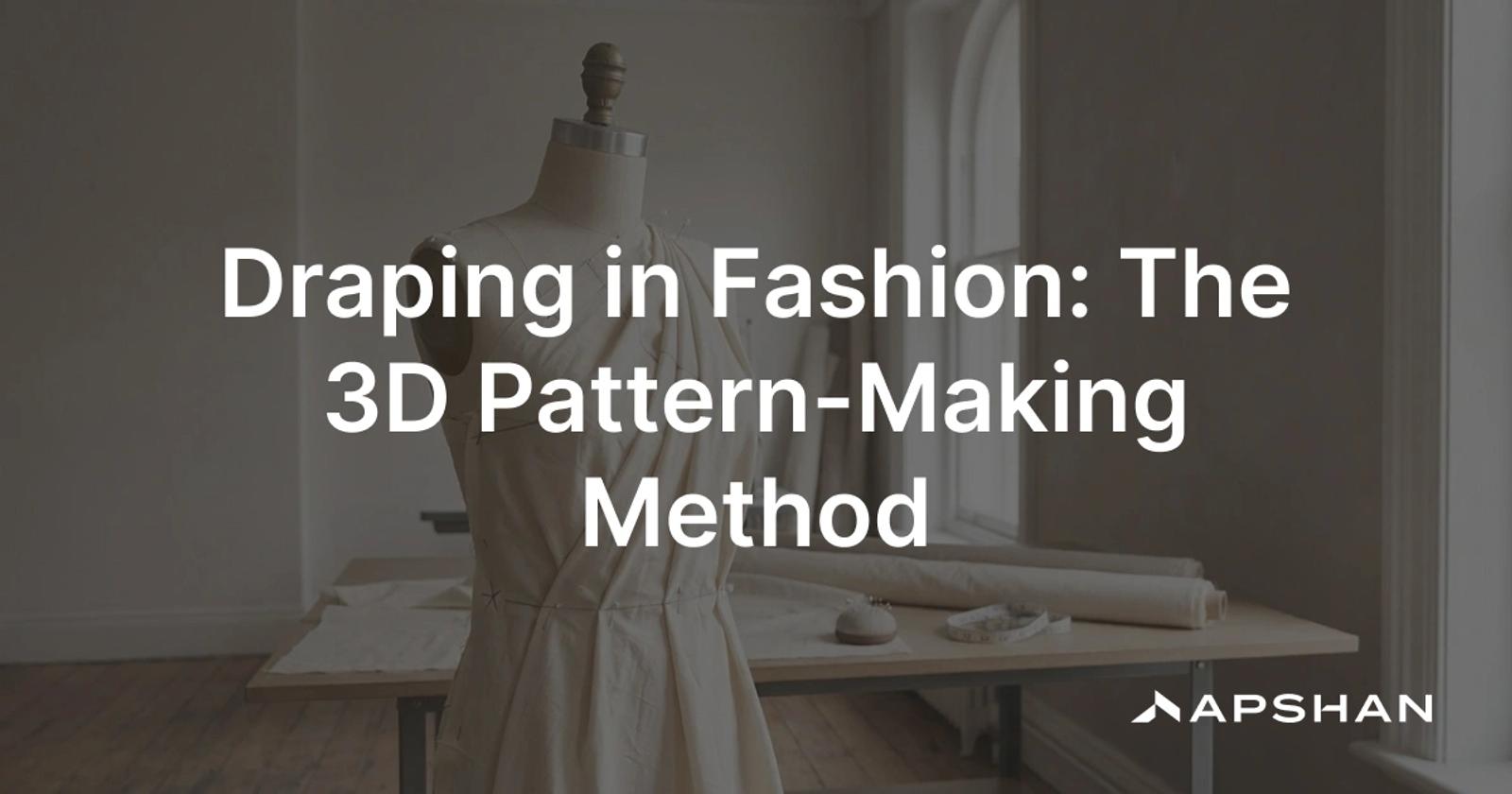
Some garments are drawn as flat measurements, and some are discovered on the body. Draping is how the second kind gets made: the designer works the fabric on a dress form until the shape is right, then turns that into a pattern. It is a pattern-making method, not a finishing touch, and for soft or bias designs it is often the only way to find the shape.
This guide covers what draping is, how it differs from flat pattern-making, how the process actually works, and where it sits in product development, before a design becomes a tech pack.
What is draping in fashion?
Draping is a pattern-making method in which the designer shapes fabric, usually muslin, directly on a dress form in three dimensions to develop a garment. Once the shape is right, the fabric is marked, removed and trued onto paper to make a flat pattern. It produces a pattern, not a finished garment.
It is sometimes called modelling on the stand. The point is to see and feel the garment in three dimensions as it is made, which is why it suits designs whose shape cannot be predicted on paper. A cowl neck, a bias-cut gown or a softly gathered bodice is far easier to resolve on the form than to draft from measurements.
Draping vs flat pattern-making
There are two ways to develop a garment pattern, and draping is one of them. The other is flat pattern-making, and the difference is where you start.
- Draping: starts in three dimensions, with fabric on a form; the designer sees the shape and the drape in real time and works it by hand. Best for fluid, bias, asymmetric and sculptural designs, and the method behind most couture.
- Flat pattern-making (drafting): starts in two dimensions, drafting lines and curves on paper from body measurements and a foundation pattern called a block or sloper. Precise, repeatable and easy to grade across sizes; best for structured, tailored and high-volume garments.
Neither is better; they answer different problems. Flat pattern is fast and exact for a tailored jacket or a repeatable block; draping is how you find the shape of a cowl, a bias gown or an asymmetric drape that no formula predicts. Most workrooms use both, often on the same garment: flat-pattern the structured base, drape the sculptural part.
How draping works, step by step
Draping follows a consistent process, and the steps are what turn a piece of cloth into a usable pattern.
- Prepare the muslin: cut, block and press the toile fabric, and mark its grainlines, because the grain has to sit true on the form just as it will on the body.
- Shape it on the form: pin the fabric to the dress form and work in the darts, tucks, gathers and seams that give the garment its shape and fit.
- Mark on the form: while the fabric is still pinned, mark the seam lines, style lines, darts and notches, so the shape is recorded exactly as it looks.
- True it on the table: remove the muslin, lay it flat, and true the marks, using rulers and curves to smooth and finalise the lines so corners are sharp, curves clean and seam lengths match.
- Transfer to paper: copy the trued muslin onto pattern paper, add seam allowances and notches, and you have the first flat pattern; pin it back on the form to check the fit.
One rule runs through all of it: drape in a fabric that behaves like the final cloth. Muslin is the standard toile fabric, but a bias or fluid design has to be draped in something close to the real fabric's weight and drape, or the shape you approve on the form will not be the shape you get in production.
When to drape and when to flat-pattern
For a brand, the choice between draping and flat pattern is a design, fabric and cost decision, and it usually comes down to the silhouette and the fabric.
- Drape when: the design is fluid, bias-cut, cowled, asymmetric or sculptural, or the fabric's own drape has to guide the shape; also for one-offs, couture and fit exploration.
- Flat-pattern when: the garment is structured or tailored, built on an existing block, or headed for repeatable, graded production where precision and speed matter most.
- Do both when: a garment has a structured base and a draped detail; drape the part that needs it and draft the rest, then reconcile them into one pattern.
The fabric decides as much as the silhouette. A bias or soft design cannot be judged in stiff muslin, and a crisp tailored shape gains nothing from being draped; matching the method to the cloth is half the skill.
Where draping fits in product development
Draping is the front of the development process, not the whole of it. What it produces still has to become something a factory can make.
- Drape to a first pattern: the drape is trued and transferred to paper, giving the first flat pattern, which is then cut as a toile or sample to check the design on the body.
- Refine, then grade: the pattern is corrected through fit samples, then graded across the size range, which is a flat-pattern operation, not a draping one.
- Specify it: the finished pattern, its measurements and construction are recorded in the tech pack so the factory reproduces the garment the designer shaped.
So draping is design and fit exploration; grading and the tech pack are how the result becomes producible at scale. The real value of draping for a brand is knowing when a design actually needs it, because some shapes simply cannot be drafted flat, while paying for it on a plain tailored block is wasted cost.
Draping, drape, and the digital pattern
Two clarifications matter, one about words and one about tools.
- Draping is not drape: draping is the method, working fabric on a form; drape is how a fabric falls and folds. You drape a design because its drape can only be judged in three dimensions, but the two words are not the same thing.
- Draping and digital: modern workrooms increasingly drape virtually, shaping a garment on a 3D avatar in software, or drape in cloth and then digitise the pattern; either way it is flattened, graded and specced for the factory floor.
Draping is the older of the two approaches, since shaping cloth on the body came long before drafting it flat, and its modern master is Madeleine Vionnet, who built her bias-cut couture by working fabric directly on the form rather than sketching it, letting the cloth and the body find the shape. That inheritance is why draping still sits at the heart of couture, and of any design where the fabric, not a formula, has to lead.
Draping is one method in a garment's construction story, tied to the pattern, the fabric and the cost of every unit. Apshan structures that fashion knowledge, cited to source, so a design decision is grounded rather than guessed. Request access or see the plans and pricing.