
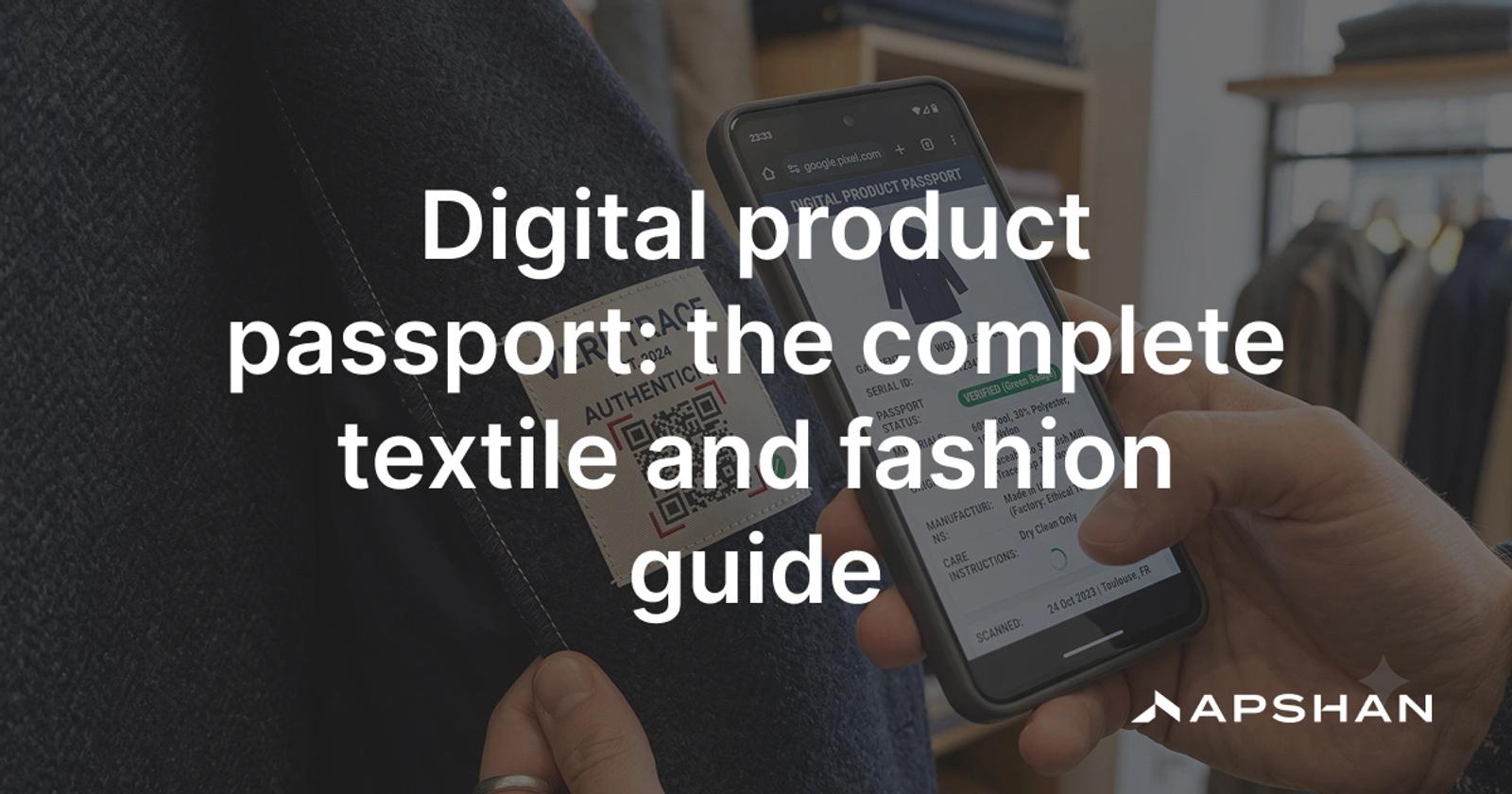
Within a few seasons, every garment sold in the European Union will carry a QR code that opens its full identity card: composition, origin, substances, repairability, end of life. That is the digital product passport, and textiles are the first consumer sector in line.
Brands that structure their product data now will meet the deadline in quiet compliance. The rest will discover in 2028 that a passport cannot be filled in three months. Here is what is settled, what is still indicative, and where to start.
What is a digital product passport?
A digital product passport, or DPP, is a mandatory digital identity attached to every product placed on the EU market. It is created by the EU Ecodesign for Sustainable Products Regulation, the ESPR (Regulation (EU) 2024/1781), which entered into force on 18 July 2024.
In practice, a physical data carrier on the product, usually a QR code, an NFC chip or an RFID tag, points to a structured set of data on the composition, durability, repairability, substances of concern and end of life of the product.
The ambition goes beyond the label: make product data readable by consumers, authorities, recyclers and repairers, each according to their access level. Some information will be public, some reserved for actors with a legitimate interest. The recycler sees the substances, the market surveillance authority sees the conformity file.
The passport is only half the story
The ESPR is not limited to information. Its delegated acts will also set performance requirements: minimum durability, repairability, recycled content. The passport is the visible layer of a deeper redesign, where a garment can be barred from the EU market because it is built not to last.
That is the real shift for fashion: ecodesign stops being a marketing argument and becomes a market condition. Textiles and apparel are the first non-energy mass-consumer product addressed, which makes the sector the full-scale test of the whole European policy.
Beyond information, the ESPR lets the Commission set binding ecodesign requirements for a product group. For textiles, the levers under study are concrete:
- Durability: minimum performance thresholds so a garment is built to survive real use, not one season.
- Repairability: design and spare-part logic that makes repair viable rather than theoretical.
- Recycled content and recyclability: a minimum recycled share and design for fibre-to-fibre recycling, penalising blends that cannot be separated.
- Restrictions on destruction: the unsold-goods ban is already the first of these to bite.
Where the DPP fits in the EU textile rulebook
The passport is not a standalone rule. It is one moving part in a fast-tightening machine of EU textile regulation, and reading it in isolation is how brands miss the overlaps. The map, in five pieces:
- The ESPR, the passport's parent. The Ecodesign regulation creates both the DPP and the future ecodesign requirements (durability, repairability, recycled content) for textiles.
- Extended producer responsibility (EPR). Producer-pays schemes that fund end-of-life. France has run one since 2007; separate textile collection has been required across the EU since January 2025, and the revised Waste Framework Directive (in force October 2025) now obliges every member state to set up a textile EPR scheme, with schemes due by 2028.
- Green claims rules. The Empowering Consumers Directive and the proposed Green Claims Directive police environmental claims, the same claims a passport's data will either support or expose.
- National precursors. France's AGEC environmental product sheet has required composition, recyclability, traceability and substances data since 2023: effectively a national dry run for the passport's dataset.
- Unsold-goods rules. Since 19 July 2026 the ESPR already bans large companies from destroying unsold clothing, accessories and footwear across the EU: the first ESPR measure to bite for fashion, ahead of the passport itself.
- Textile labelling. The existing EU textile fibre-labelling regulation already mandates composition disclosure, and it is the legal anchor the passport's composition field builds on rather than replaces.
These rules are not a menu to pick from. They overlap by design: the same supply-chain data feeds the passport, the producer-responsibility declaration and the environmental claim a brand makes on its own site. Collected once, it answers several obligations, which is exactly why treating it as scattered compliance paperwork is the expensive mistake.
The passport ties these threads together, because it is the layer where all of this data becomes machine-readable at once. Building the map is a job in itself, and it is the reference layer we build at Apshan.
When does the DPP apply to textiles?
Textiles sit in the first ESPR wave. The textile delegated act is expected around 2027 and the first apparel obligations around 2028, but only the 2024 to 2026 dates are firm. The calendar is built delegated act by delegated act, sector by sector.
- 18 July 2024: the ESPR enters into force, the general framework.
- 16 April 2025: the Commission adopts its first ESPR working plan for 2025 to 2030. Textiles and apparel are a top-priority product group, alongside tyres, furniture and mattresses, plus steel and aluminium as intermediates.
- 19 July 2026: the EU ban on destroying unsold clothing and footwear takes effect for large companies, the first live ESPR measure for fashion.
- 18 February 2027: the battery passport becomes mandatory (Regulation (EU) 2023/1542). It is the first DPP in real conditions, and textiles have every reason to watch it.
- Around 2027: indicative adoption of the textile delegated act, apparel excluding footwear, which will set the precise requirements.
- Around 2028: first application obligations for apparel, with roughly 18 months of preparation after the act is adopted.
- By 2030: progressive generalisation to all textile products placed on the EU market.
An honest caveat: only the 2024 to 2026 dates are set in stone. The 2027 textile date is the Commission's working target, not yet an enforceable deadline. That is precisely the useful window, the time to prepare still exists.
The battery passport is the dress rehearsal
Batteries take the first hit a year before textiles, and everything is already visible there: a passport at item level rather than model level, QR-code access, responsibility resting on the operator that places the product on the market, sensitive data reserved for legitimate actors.
The technical standards, data formats and registries that stabilise there will serve as the template for the delegated acts that follow. Watching that build is reading the textile spec sheet a year early.
What will a textile passport contain?
The delegated act will fix the exact list. The ESPR framework and the preparatory work already sketch the probable contents. Expect a core dataset:
- A unique product identifier, at model, batch or item level depending on what the act retains.
- Fibre composition and materials, in line with the textile labelling regulation already in force.
- Substances of concern present, so that clean recycling is possible.
- Recycled content and recyclability of the product.
- Durability and repairability data, with a score in preparation at the JRC, the Commission's research centre.
- Traceability and end-of-life information: who made what, where, and how to collect the product once used.
What the JRC's preparatory work signals
The JRC's apparel work (product group 467) gives the temperature. The scope under study covers garments made of at least 80 percent textile fibres, sportswear and workwear included, and scoring where design counts: a heavily elastane jean loses recyclability points, for example. Nothing is final, but the direction is clear, material data becomes a design decision.
The JRC's third apparel milestone went further, sketching proposed ecodesign requirements on top of the passport. The direction under discussion adds a recyclability score from 0 to 10 that rewards clean, homogeneous fibre composition and penalises the hardest-to-recycle blends, with products above roughly 15 percent elastane scoring lower, alongside possible minimum recycled-content thresholds still under assessment. A life-cycle assessment underpins the scoring, so a garment's grade reflects how it was designed, not what it claims.
Who sees what: the access tiers
Not all passport data is public. The ESPR foresees tiered access so the same record serves different readers without exposing everything. Consumers get care and composition basics; recyclers get substances and disassembly data; market surveillance authorities get the full conformity file; commercially sensitive data stays restricted. The design is meant to reconcile transparency with trade-secret and data-protection concerns rather than dump every field into public view.
Why brands selling in France have a head start
Good news for brands already compliant with French law: France ran the rehearsal. Since 2023, the AGEC environmental product sheet has required publishing recycled content, recyclability, hazardous substances, traceability of the manufacturing steps and the presence of plastic microfibres.
That is, near enough, the data backbone of the future passport. A brand that can already say where its products are woven, dyed and made has done the hardest part. The French environmental cost display adds a cost layer, distinct but fed by the same data.
Run the inventory: country of weaving, dyeing and making-up, recycled share, substances, proportion of synthetic fibres. If your French product sheet is up to date, four of the passport's six probable data blocks already exist in your systems. What remains is the unique per-product identifier and the durability data, the two genuinely new build sites. Our guide to textile sourcing and sustainable sourcing covers where that supply-chain data comes from.
QR code, NFC or RFID: which data carrier?
The regulation requires a machine-readable physical data carrier on the product, its packaging or its documentation. For apparel, three options dominate:
- The QR code: cheapest, printable on the woven label or the hang tag. The default choice for ready-to-wear.
- The NFC chip: read by smartphone without an app, favoured at the high end for customer experience and authentication.
- RFID: readable at distance and in bulk, already deployed in logistics, Decathlon being the most advanced example, which kills two birds, inventory and passport.
Luxury did not wait for the obligation: several houses already attach a digital identity to their pieces, as much for traceability as for the fight against counterfeiting. The regulatory duty lands on ground the market has started to clear.
What happens to a brand without a passport?
The main sanction is not a fine, it is market access. Once the delegated act applies, a product without a conforming passport can no longer be placed on the EU market, on the same footing as a product without CE marking.
The regulation sets up a central registry of identifiers and brings customs authorities into the controls: the passport identifier can be checked at the border. This mechanism targets low-cost import flows directly, which will structurally struggle to document their chains.
On architecture, the passport will be decentralised: the data stays with each operator, in their own systems, and the mechanism queries it. The technical standards that make this possible already exist. CEN-CLC/JTC 24, working under EU Standardization Request M/604, developed the first series of eight European DPP standards, and six of the eight are already cited in the Official Journal of the EU. Once cited, a standard gives its correct application a presumption of conformity. The infrastructure is stabilising, the too-early argument no longer holds.
For a brand that already controls its data, the passport is therefore less a threat than a competitive filter: it makes opacity more expensive and rewards traceability.
Who has to create and hold the passport?
The economic operator that places the product on the EU market is responsible. For a European manufacturer that is direct; for a brand based outside the EU it means the obligation is carried by its EU importer or a designated authorised representative, the same routing as CE marking.
This is where low-cost import models are most exposed. A seller shipping direct to EU consumers from outside the bloc still needs a conforming passport, and the online marketplace that hosts the sale can be pulled into responsibility. The regulation is written so that the product, not the postcode of the brand, decides the duty.
For smaller companies, the ESPR foresees proportionality and the possibility of lighter requirements, but no blanket exemption. The dataset an SME must hold is the same; the tooling around it can be simpler. The practical takeaway is identical for everyone: the passport follows the garment to the EU border, so the data has to exist before the product ships.
What will a passport cost, and who pays?
The visible carrier is the cheap part. A printed QR code on a woven label costs cents; an NFC or RFID tag costs more but is measured in small change per unit. The real cost sits upstream, in collecting and structuring the data the code points to.
That means mapping the supply chain, gathering composition and substance data from mills and dye houses, and holding it in a system that can serve it per product. It is the same spend a brand needs for the French product sheet, for environmental-claim substantiation and for basic sourcing control, which is why the honest framing is not compliance cost but data asset: the work pays off in more than one regulation.
What to do now: five workstreams
No need to wait for the delegated act to begin. The data to assemble is 80 percent known. Five workstreams, in priority order:
- Map the chain per reference: who spins, weaves, dyes and makes up, and where. This is the slowest data to obtain, and it already feeds the French product sheet.
- Centralise product data in a structured repository: composition, weight, substances, recycled share, by model and by season. A spreadsheet per collection will not hold the passport's granularity.
- Choose your carrier level: QR on the label to start, NFC or RFID if authentication or logistics justify it.
- Track the textile delegated act and the February 2027 battery passport, the full-scale crash test whose standards textiles will inherit.
- Treat data as an asset, not a constraint: the passport becomes a traceability showcase against fast fashion, which will structurally struggle to fill it.
These steps also connect the passport to the wider fashion supply chain, where the same traceability data drives sourcing, compliance and product decisions.
What the digital product passport is not
Four myths cloud the debate. For the record, and in plain terms:
- It is not a blockchain. The ESPR is technology-neutral. A QR code pointing to a decentralised data record satisfies it; no distributed ledger is required.
- It is not one giant EU database. The data stays with each operator, in their own systems. Only a registry of unique identifiers is central; the mechanism queries the rest on demand.
- It is not a carbon label. A footprint figure may join later, but the core is composition, traceability, substances and circularity data, not a single climate score.
- It is not optional for non-EU brands. If the product reaches the EU market, it needs a conforming passport, whoever made it and wherever they are based.
The bottom line
The digital product passport is no longer a hypothesis: the regulation is in force, textiles are in the first wave, the delegated act is expected around 2027 and the first obligations around 2028. Everything will turn on the quality of product data, and that is built now, not later.
Structuring product knowledge, linking it to its sources and making it queryable is exactly what we build at Apshan with Nari for sourcing, compliance and product teams. Request access.