
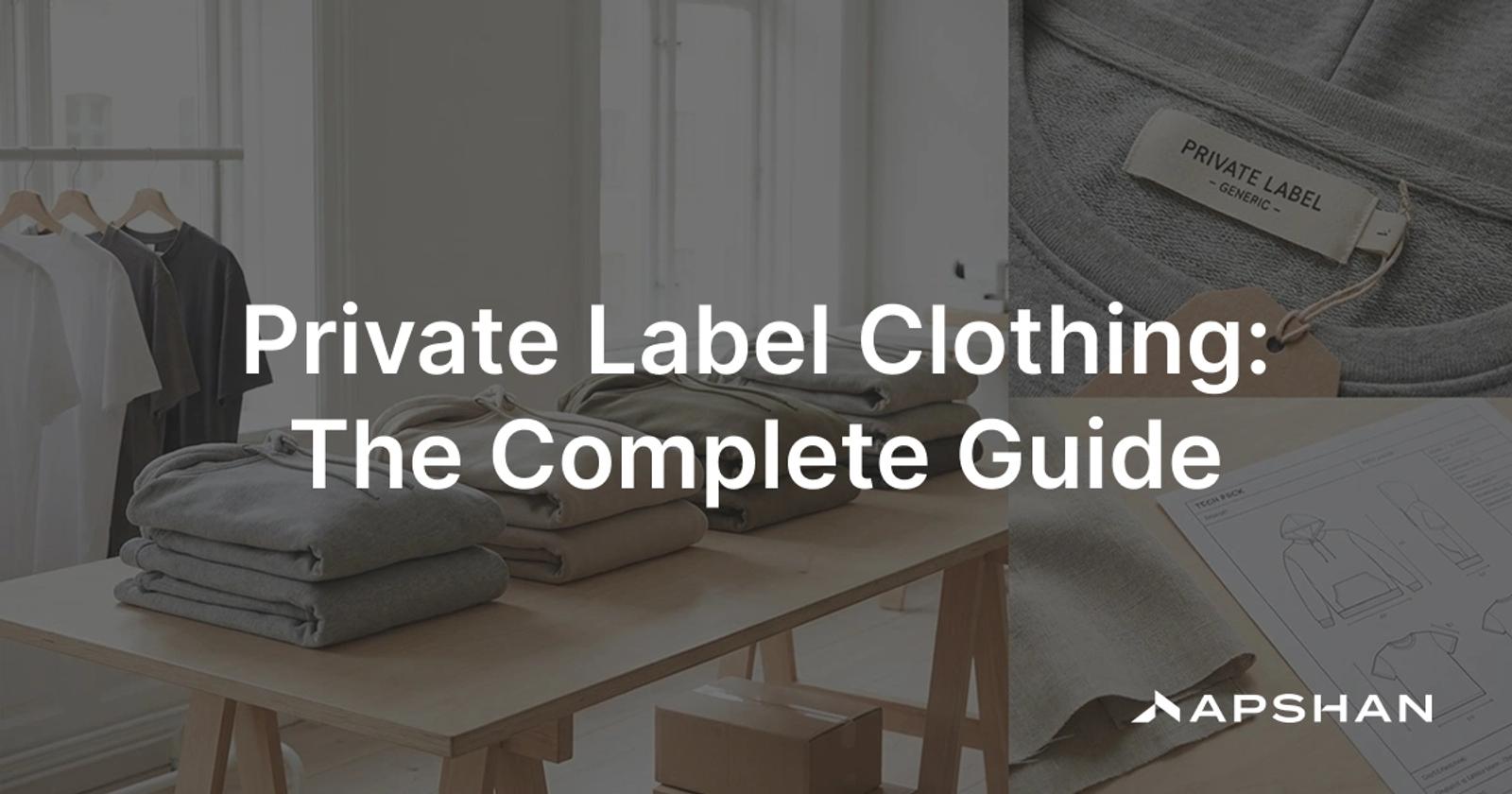
Every retailer's own-brand range, from a supermarket's basics to a fashion label's core collection, is private label clothing. It is the most common way to sell apparel under your own name without owning a factory, and for a growing brand it is often the line between a real product and a generic blank with a logo stuck on.
This guide explains what private label clothing actually is, how it differs from white label and cut-and-sew, what it costs, when it is the right move, and how to start a line, without confusing it with print-on-demand or dropshipping.
What is private label clothing?
Private label clothing is apparel that a manufacturer produces to your specifications and that you sell exclusively under your own brand. You own the design decisions, the labeling, and the customer relationship; the factory owns the production.
The level of customization varies. Some brands start from a manufacturer's existing base garments and adjust fabric, color, fit, and trims; others develop a product closer to scratch. What makes it private label is exclusivity: the finished garment carries your label and is not sold to anyone else.
That exclusivity is why store brands power so much of retail. Across US consumer goods, they now account for over a fifth of dollar sales and keep setting records, because retailers keep the margin and the brand equity instead of handing both to a national brand.
Private label vs white label vs cut-and-sew
The three terms describe how much of the product is truly yours. Private label is customized and exclusive to you; white label is generic and shared; cut-and-sew is built from your own patterns from the ground up.
- Private label: a manufacturer's product customized to your specifications, fabric, fit, trims, and labeling, and sold under your brand alone. More control and differentiation, higher minimums and cost.
- White label: a generic, ready-made product that many brands buy and rebrand as their own. Fast and cheap to launch, but you sell the same item as everyone else, with little control over fit or fabric.
- Cut, make, trim (cut-and-sew): fully custom production from your own patterns and materials. The most control and the most work, since you manage design, fabric, and grading yourself.
In practice private label sits in the middle, more yours than white label, less demanding than full cut-and-sew. For the deeper breakdown of every maker type, our guide to how to find a clothing manufacturer covers CMT, full-package, and the rest.
How private label clothing works
Private label works by pairing your brand with a manufacturer that already makes the kind of garment you want, then customizing and branding it. The broad steps are choose a maker, customize the product, apply your branding, sample, and produce.
You start by finding a factory whose specialty matches your product, then define exactly what you want with a tech pack or detailed brief, covering fabric, measurements, colors, trims, labels, and packaging.
Fabric is a pivotal decision: you either accept the factory's stock materials or specify your own, which connects directly to textile sourcing and affects both cost and quality.
Then you sample. A pre-production sample confirms the fit, fabric, and finish before you commit to a full run. Once approved, the factory produces your order, labels and packs it under your brand, and ships it to you.
The one step that decides everything is choosing the right partner. Our guide to how to find a clothing manufacturer covers where to look, MOQ, and how to vet a factory before you trust it with your money.
Pros and cons of private label clothing
Private label is popular because it balances control against effort, but it is a real commitment. The trade-offs are worth understanding before you order.
- Full brand control: your name, labels, fit, and fabric choices, so the product genuinely represents your brand rather than a rebadged generic.
- Exclusivity: the garment is yours alone, which lets you build a distinct identity and price accordingly.
- Better margins: buying production directly, without a middle brand, typically leaves more margin than reselling someone else's product.
- Room to grow: you can refine fit, upgrade fabric, and expand the range over time as you learn what sells.
The trade-offs are just as real:
- Higher minimums: private label means real production runs, so minimum order quantities are higher than white label or print-on-demand.
- Upfront capital: you pay for samples, materials, and a full order before you sell a single unit.
- Inventory risk: you own the stock, so a product that does not sell is money sitting in a warehouse.
- Longer lead times: sampling and production take weeks to months, so you plan seasons ahead, not days.
How much does private label clothing cost?
There is no single price. Private label cost depends on the garment, the fabric, the level of customization, and above all the quantity you order. The main drivers are per-unit production price, minimum order quantity, sampling, and shipping.
- Minimum order quantity: most private label factories require somewhere between about 50 and several hundred units per style, and larger factories more. This is usually the biggest commitment.
- Per-unit price: falls as quantity rises and as the garment gets simpler; complex construction and premium fabric raise it.
- Sampling and setup: expect to pay for samples, and sometimes pattern or customization work, before production begins.
- Shipping and duties: overseas production adds freight, duty, and customs costs that can meaningfully change the landed cost per unit.
Is private label clothing right for your brand?
Private label fits brands ready to invest in a differentiated, exclusive product and to hold inventory. It is less suited to someone who only wants to test an idea with no upfront money.
- A good fit if: you have a clear product vision, some capital, and want a real brand with control over fit, fabric, and margin.
- Consider waiting if: you are only validating demand, cannot meet minimums, or are not ready to hold stock. A small test run or white label may suit that stage better.
The deciding factor is usually commitment. Private label rewards brands that plan to build something lasting, and frustrates those hoping for a quick, hands-off flip.
How to start a private label clothing line
- Define the product and the customer. Decide exactly what you are making and who it is for; a focused first product beats a broad, unfocused range.
- Validate what will sell. Before you commit to minimums, gather as much signal as you can on demand, colors, and sizes, so you order product the market actually wants.
- Create your specs. Turn the idea into a tech pack or detailed brief the factory can quote and produce from.
- Find and vet a manufacturer. Shortlist factories whose specialty matches your garment, then check MOQ, samples, and communication before you commit.
- Sample before you commit. Approve a pre-production sample for fit, fabric, and finish, then order a small test run.
- Brand it properly. Labels, hang tags, and packaging turn a generic garment into your product; this is where private label earns its exclusivity.
- Produce and launch. Place the first order, plan the reorder, and use early sales data to refine the next run.
Private label vs print-on-demand and dropshipping
Private label is often confused with print-on-demand and dropshipping, but they are different commitments. True private label means producing real garments to your own specifications and holding inventory; print-on-demand and dropshipping avoid inventory by selling generic products made or shipped only after a sale.
- Print-on-demand: a supplier prints your design onto a stock blank when an order comes in. No inventory, but you are limited to their blanks and their quality, with thin margins.
- Dropshipping: you sell a third party's generic product and they ship it; you never handle it, customize it, or control it.
Both can help you test an idea with little money, but neither builds a differentiated product or lasting brand equity. If your goal is a serious label with control over fit, fabric, and finish, that is private label, not a print-on-blank side hustle.
Common mistakes with private label clothing
A few mistakes turn a promising private label launch into dead stock and lost cash. Most are avoidable with patience and preparation.
- Treating it like dropshipping: expecting a passive, hands-off business. Private label needs real decisions on product, quality, and inventory.
- Ordering before validating demand: committing to minimums on a guess, then owning hundreds of units nobody wants.
- Mismatching the factory to the product: a maker who excels at one category can be wrong for yours. Fabrics, machines, and techniques differ by production line, so confirm the factory already makes your exact type of garment.
- Underestimating the commitment: forgetting that minimums, samples, and lead times all cost money and time before the first sale.
- Weak branding: slapping a logo on a stock item without real customization, which leaves you with white label economics and no differentiation.
- Skipping the sample: approving a production run without seeing and feeling a physical sample first.
Decide what to make, not just who makes it
Choosing private label answers how you will produce. The harder question is what to put in the line, because exclusivity only pays off if the product is one people actually want.
That is a demand question. Knowing which styles, colors, and sizes will sell, before you commit a minimum order, is what separates a profitable private label range from a warehouse of guesses. It is the same intelligence behind merchandise planning and a well-run fashion supply chain.
Apshan builds that layer, a connected, sourced signal on fashion demand, so you brief a manufacturer for products the market actually wants rather than betting a full order on instinct. Request access or see the plans and pricing.